As summer drags on, so too do road projects around the area. Several of the projects underway affect the Westside — directly or indirectly — affecting each of our daily lives. Some projects hope to improve road safety, some add artistic beauty to an otherwise drab area, and others look for ways to heal historical divides.

Part of the project on the 400 South viaduct includes the installation of public art that pays homage to the peacock. Reflective tape and translucent panels will feature color palettes from across the valley, creating a rainbow of colors often found in a peacock’s feathers. Photo courtesy of Salt Lake City.
400 South Viaduct
Construction has officially begun on the 400 South viaduct — the portion of 4th South that goes from I-15 to downtown, crossing over the railroad tracks.
The project, which involves both Salt Lake City and UDOT, will result in the construction of a multi-use trail along the south side of the road. This path is expected to provide more opportunities for folks who would rather walk, bike, or roll between the west and east sides of the city. The trail will connect to bike lanes on 900 West, 300 West, 200 West, and will link to public spaces like Pioneer Park.
The city says the project will maintain the current vehicle capacity in the area from 900 West to 200 West.
Part of the project also includes the installation of public art — helping to make the trail more aesthetically pleasing and inviting, while also highlighting the unique character of the area.
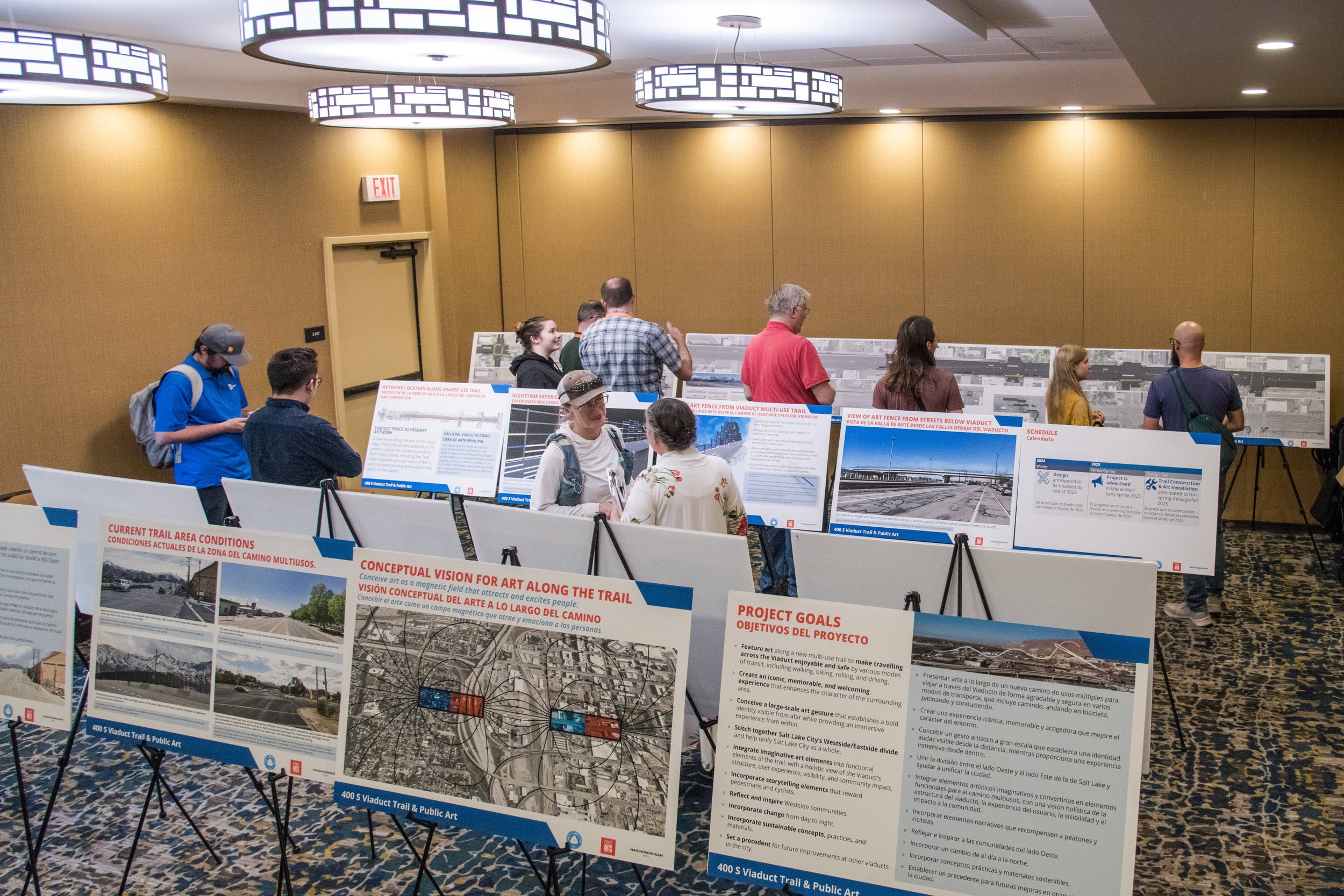
Salt Lake City hosted an open house on October 23, 2024 to share plans for the upcoming 400 South Viaduct Trail and Art project. Project team members and artists were present to answer community members' questions and share more about the project. Photo by David Ricketts.
At an open house earlier this year, residents of Poplar Grove gave their feedback on the kind of art that would be included in the project. Ultimately, it was decided that the artwork along the 400 South viaduct would include references and homages to the beloved peafowl.
“The art will be built into the viaduct fencing, with wave-like patterns that echo the nearby Jordan River,” explained the city on the project’s website. Reflective tape and translucent panels will feature color palettes from across the valley — like the Great Salt Lake’s blue and purples, and the mountain greens and oranges — culminating in a bold ‘full peacock’ on the Poplar Grove side of the viaduct as an entrance to the neighborhood.”
During construction, commuters can expect to see lane closures, a reduction in on-street parking, and night/weekend work.
The project is expected to wrap up by November.
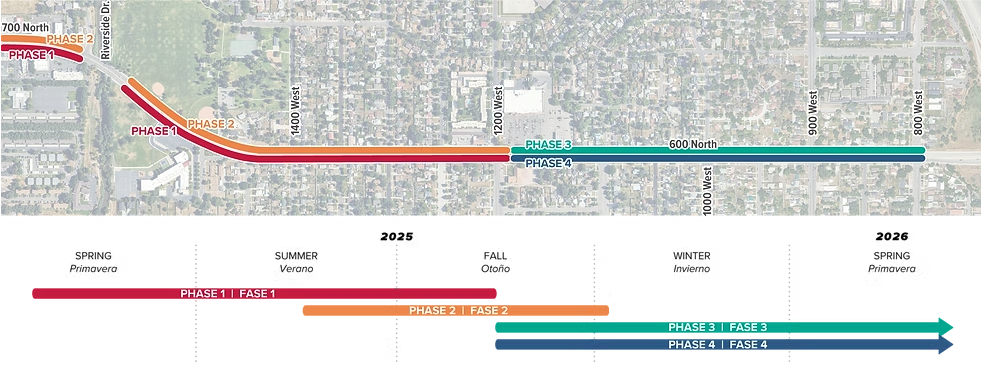
Construction on Phases 1 and 2 of the 600/700 North rebuild is expected to wrap up this Fall. Phases 3 and 4 will begin around the same time, meaning construction could be ongoing all the way from Redwood Road to 800 West. Graphic courtesy of Salt Lake City.
600/700 North Reconstruction
Construction continues on one of the busiest roads in the Rose Park area: 600 and 700 North.
After roughly 5 years of planning, the city began reconstruction of the road in April. During the rebuild, crews will conduct several roadway improvement projects, including repairing soft spots under the existing road, removing and replacing asphalt, replacing curbs and gutters, upgrading storm drains, adding mid-block crosswalks, adding protected bike lanes, and installing new trees and a more uniformed look along the entire corridor.
“After years of planning and coordination, I’m incredibly excited to see the construction start. It’s been an honor to serve this community and help bring this project to reality,” Salt Lake City Transportation Engineer Kyle Cook told The West View’s Sheena Wolfe in the Spring. Cook has spearheaded the project from its conception. “We thought it would be good to have construction phases in order to keep the road open and mitigate delays.”
Phases 1 and 2 are currently underway, resulting in lane closures and other diversions on 600 and 700 North between Redwood Road and 1200 West; this is expected to wrap up by the end of August. Later this Fall, Phases 3 and 4 will begin, moving the construction on 600 North all the way from 1200 West down to 800 West.
Travelers in the area should continue to expect lane closures, noise, dust, vibrations and lots of traffic cones.
A separate project to rebuild the bridge over the Jordan River is still in the design phase. The bridge is expected to be rebuilt by the end of 2026. During construction, a closure and detour of up to 8 months is expected.
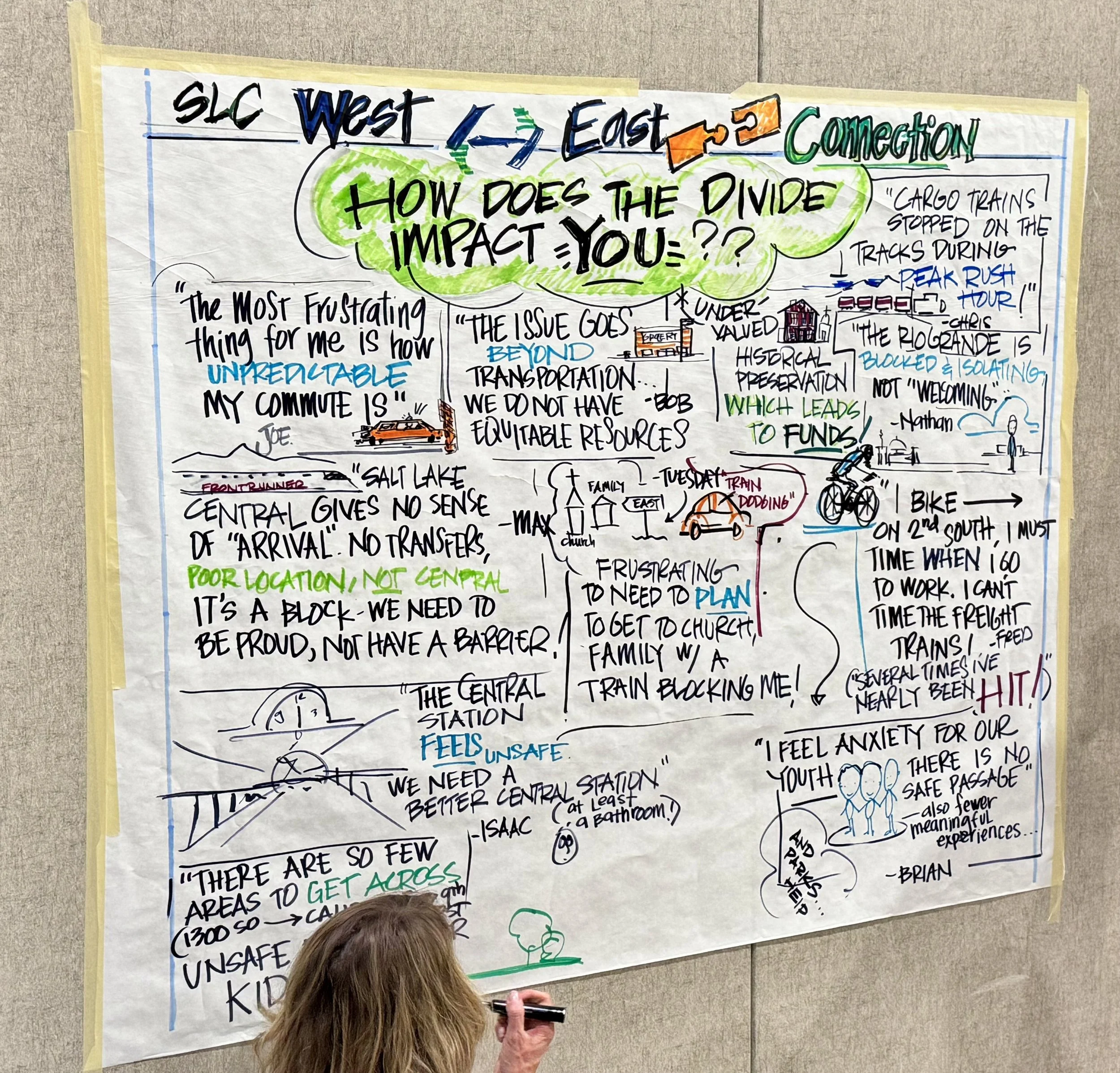
Residents attending an open house for the West-East Connections Study outline several ways the divide between west and east impacts their daily lives. Photo by Andy Cupp.
West-East Connections Study
Salt Lake City continues moving forward with its study of west-east connections across the city.
A survey to gauge how residents felt about west-east routes wrapped up in June; the results haven’t been released at this time.
An open house in May brought out a few hundred residents, each voicing their concerns with the current routes and their hopes for better routes in the future. City leaders and staff were on-hand to answer questions and hear concerns; they also wanted to know some specifics, like the area people avoid right now due to poor transportation opens, the areas people usually cross the train tracks, and what people on the Westside would like to see more of.
Residents were given the opportunity to write their ideas and frustrations on sticky notes that were attached to maps of the area. In their comments, many Westsiders spoke about the lack of infrastructure and maintenance for routes that connect the Westside to the rest of the city. Many spoke specifically about the frustrations with railroad crossings.
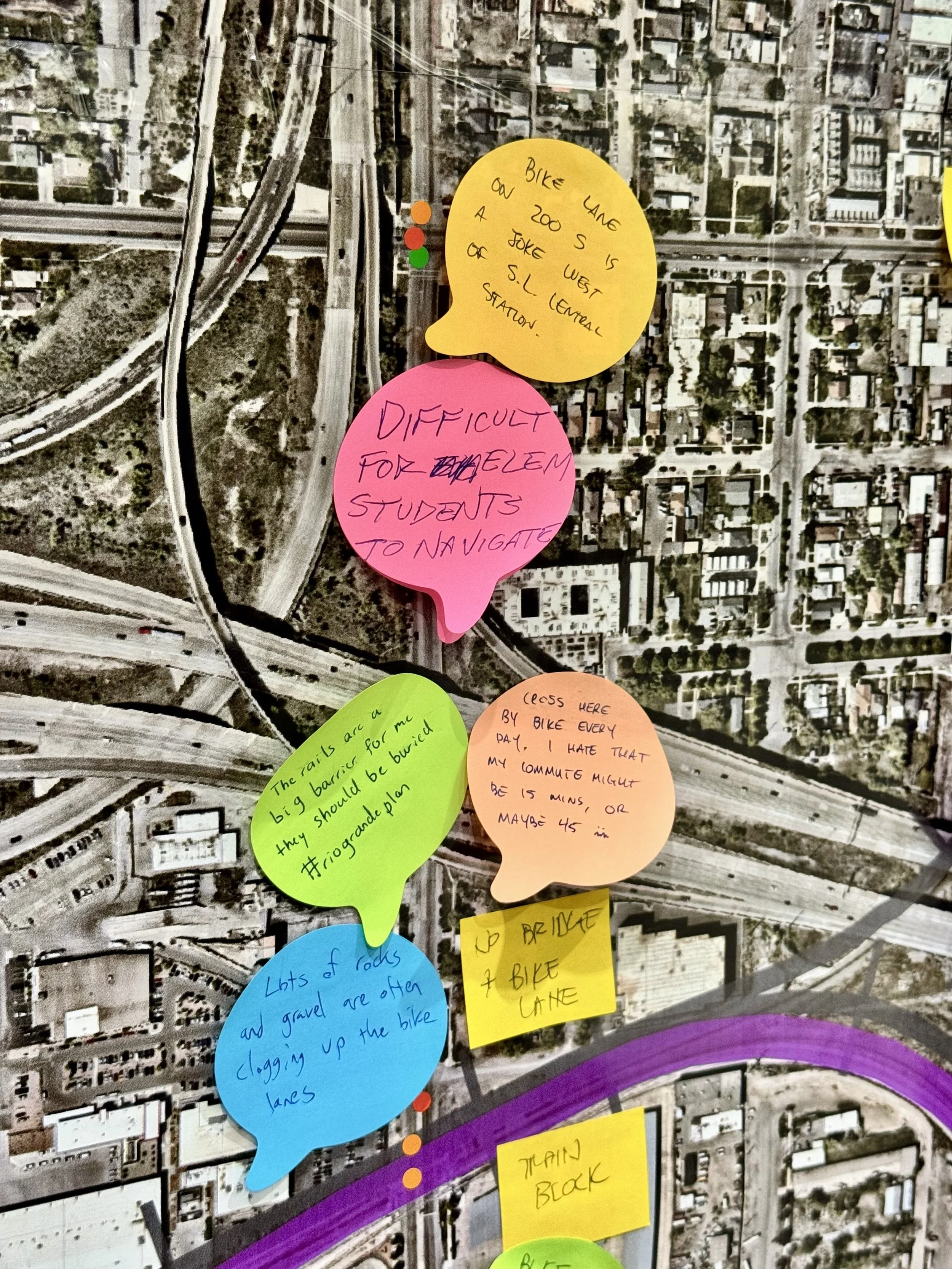
During the open house, Westsiders had the chance to place sticky notes on a large map, explaining their frustrations with specific areas of the Westside and the connections to the Eastside. Many wrote about issues with non-vehicle transportation and often being stopped by trains. Photo by Andy Cupp.
“[I’m] stopped by the train literally every single day,” wrote one frustrated resident. “I have to go way out of the way to get to community meetings,” wrote another. A third resident wrote, “You can’t plan how long [the train] is going to take.”
19 Community Advisory Board members have been selected and will continue to help guide the city throughout the process. Additional opportunities for community engagement and input are planned throughout the next year and a half.
The city hopes to have a unified plan published by the end of 2026.
Funding for this project comes from a grant from the United States Department of Transportation (USDOT) as part of the Reconnecting Communities Pilot Program.
