

Construction on the 600/700 North roadway has begun, starting with the south side of the road from 1200 West to Redwood Road. Residents and travelers can expect slowdowns, some sidewalk blockage, increased noise and dust, and vibration due to heavy equipment.
Construction to upgrade 600/700 North from 800 West to Redwood Road has begun. During the first phase, construction will focus on the south side of the road from 1200 West to Redwood Road. There will be four phases of construction over the next few years.
Construction on this minor arterial – which when completed will maintain the four existing travel lanes – will be ongoing through the spring of 2026. Phases one and two, from 1200 West to Redwood Road, are expected to be complete by winter of this year. Phases three and four, from 800 West to 1200 West, will start in the fall and take approximately eight months to complete; it will start with the north side.
The overall project includes replacing the pavement along the corridor, adding curb-protected bike lanes and new crosswalks, upgrading existing sidewalks, and removing compromised trees in the park strips. Landscaping will also be implemented along the corridor’s park strips – including the planting of dozens of new trees.
“After years of planning and coordination, I’m incredibly excited to see the construction start. It’s been an honor to serve this community and help bring this project to reality,” said Salt Lake City Transportation Engineer Kyle Cook, who has spearheaded the project from its conception. “We thought it would be good to have construction phases in order to keep the road open and mitigate delays.”
Except during the Jordan River Bridge replacement across the Jordan River, at least two lanes along the 600/700 North corridor will remain open during the 13-month construction, said Cook. He added that since part of the project includes removing existing asphalt and replacing it, redoing the curb and gutter, and upgrading the park-strip landscaping, residents and commuters using 600/700 North can expect slowdowns and periodic disruptions to driveways and side streets. He suggests that commuters use North Temple, Redwood Road, 900 West, and 1000 North to avoid delays. Residents along the 600/700 North corridor can also expect some sidewalk blockage, increased noise and dust, and vibration from heavy equipment during the more than year-long construction.
Work to rebuild the Jordan River Bridge will take eight months, during which the road in that area will be completely closed, said Cook. This separate project is a joint effort between the Utah Department of Transportation and the city. A contractor for this project is expected to be selected by the end of June, with work beginning shortly thereafter.
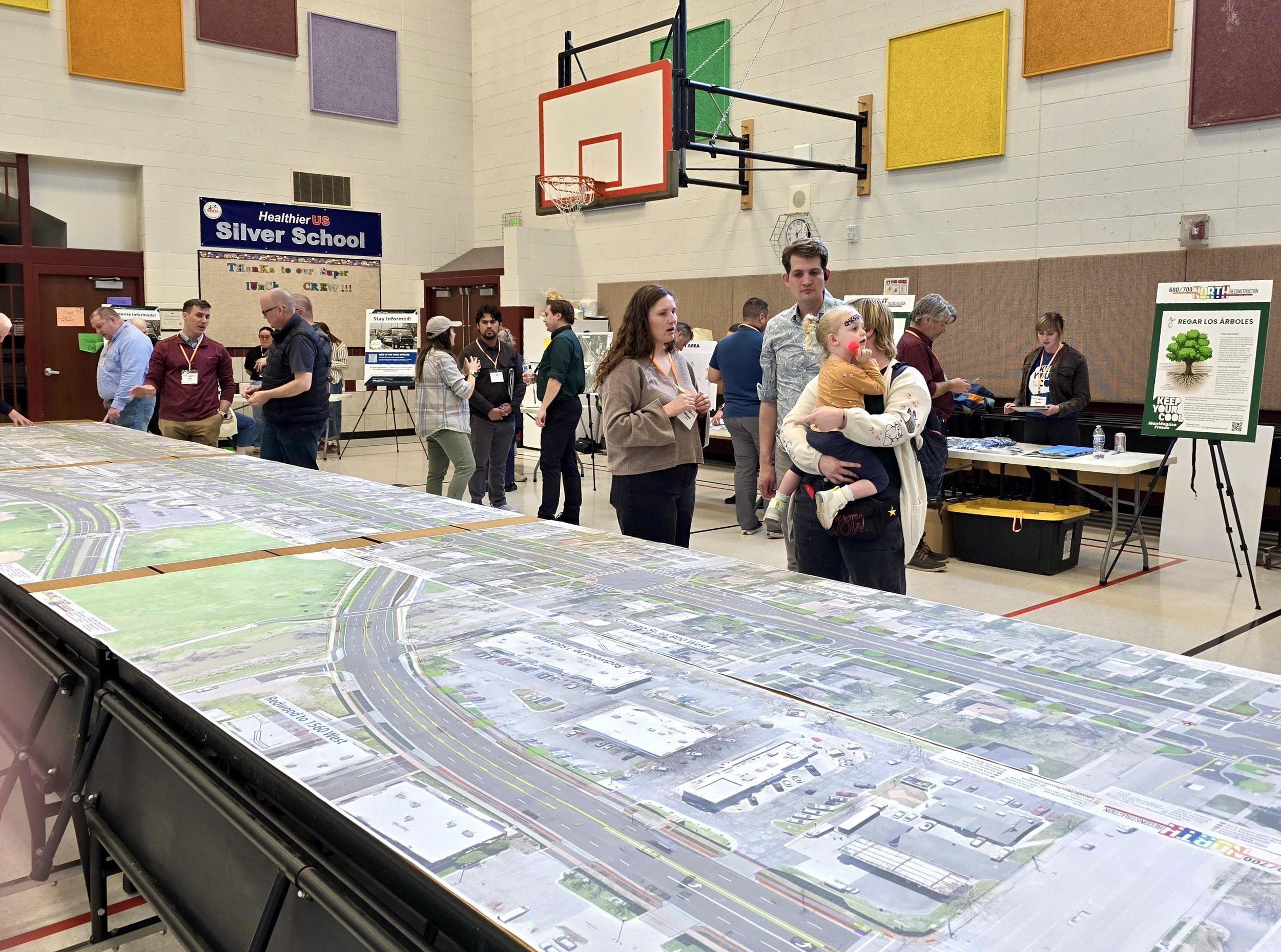
Rose Park and Fairpark residents review the final road design along the 600/700 North corridor at a Salt Lake City Open House held in April just before construction began.
Since 2020, the Salt Lake City government has held several community meetings and considered more than 1,500 public comments. They’ve also used technical research, traffic analysis, and citywide plans and goals as they’ve crafted the final design, said Cook. “Though we are no longer in a place where changes to the design can be made, we are ready to respond to comments, concerns, and questions,” said Cook.
Cook also noted that the planning process had significant constraints due to the width of the corridor and existing utilities, storm drains, curbs and sidewalks. The overall design, he said, creates a more welcoming corridor, improves safety, and provides more comfortable access for people walking, biking, and using transit. The design will also lower vehicle speeds on the 35-mile-an-hour minor arterial by using narrower lanes, center medians, and curb extensions, which also serve to shorten the crossing distance for pedestrians at crosswalks.
The bridge construction uses federal funds and is being spearheaded by the Utah Department of Transportation. Funds to finance the street’s redesign have been allocated from several sources, said Cook, including $2.4 million from UDOT and $9.7 million from an existing sales tax bond.
Why the need for reconstruction in the first place?
Statistics show that the street is heavily utilized by surrounding neighborhoods to get to existing freeways and to other parts of town. It’s also used as a pass-through by cars coming off the freeways to gain access to Redwood Road, said Cook, noting that most drivers on the street exceed the 35 mph speed limit.
The existing conditions of the road, curbs, park strips and sidewalks aren’t great, said Cook. “Much of the surface pavement is in poor condition. Sidewalks exist but the quality varies; cracking and lifting from tree roots are a problem, as well as the pedestrian ramps at intersection corners. Unmaintained or hodgepodge park-strip landscaping also impacts the quality of the sidewalk space and the overall aesthetics of the road,” Cook added. “This is a major investment, and it will truly be a more comfortable and welcoming street when it’s completed.”
For ongoing information on the 600/700 North reconstruction, as well as the bridge removal and rebuild, go to www.600northslc.org. Interested parties can also call a designated hotline at (801) 618-1003 or sign up for email updates by emailing to 600North@slcgov.com.