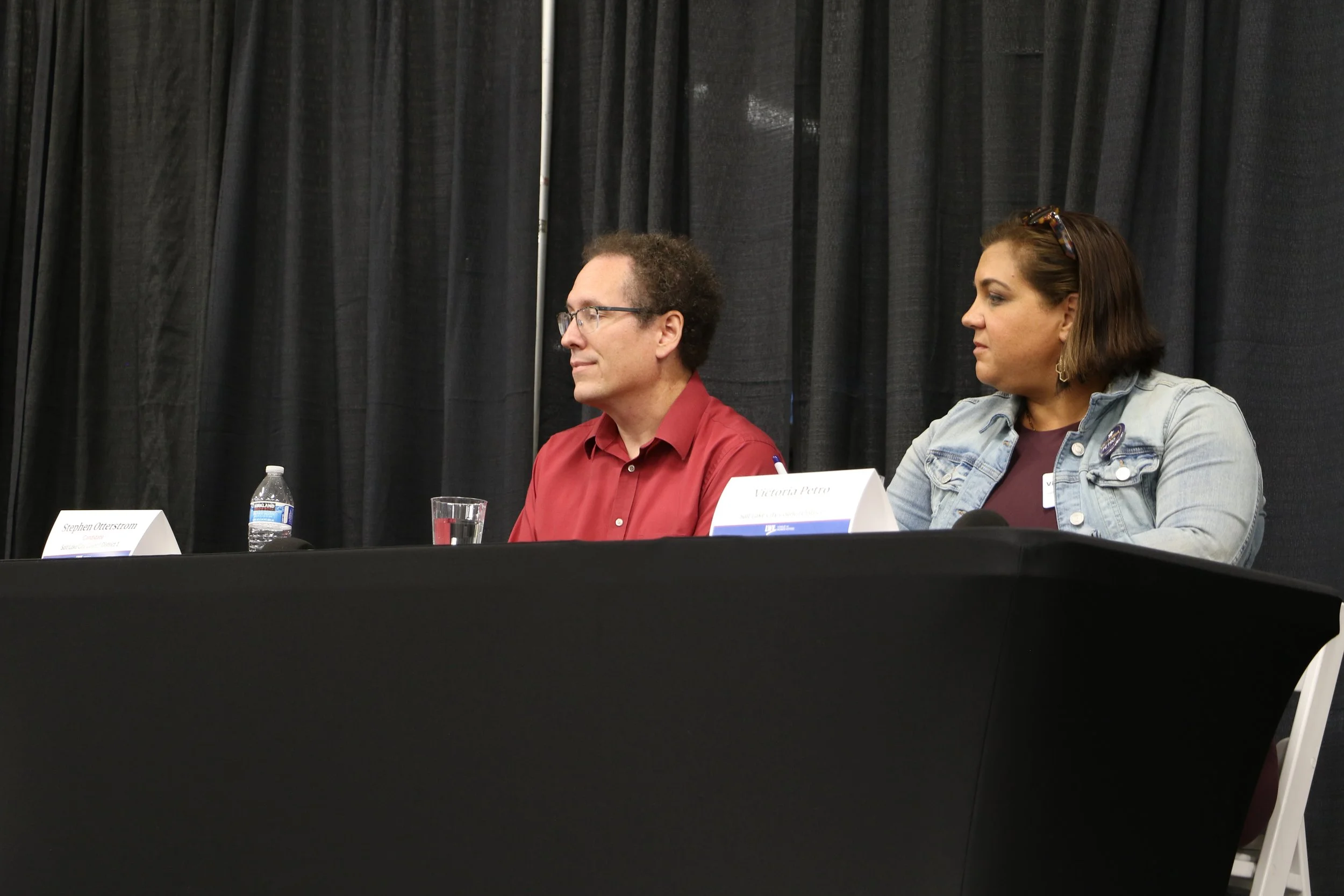
Two of the candidates running to represent Salt Lake City’s 1st District — which covers much of the Westside — took part in a community forum to share their thoughts on various issues. Incumbent Victoria Petro sits on the right; challenger Stephen Otterstrom sits on the left. The third challenger, Yussuf Abdi, did not attend the forum. Photo by Angie Toone.
Ballots for the 2025 Municipal General Election have been sent out. Leading up to the election, many candidates have made themselves available for questions and public input.
In our constitutional republic, it’s crucial to participate in elections. Part of participating means learning about each candidate and their priorities, which candidates often provide opportunities to do. Nearly every Westside neighborhood was represented at one such opportunity — the Westside Forum: Candidates and Community Conversations event held on September 30. It was organized by The West Side Coalition and League of Women Voters.
Two of the three candidates running for District 1 participated in a lively panel discussion centered around key issues affecting the Westside. Prior to the panel, members of the community engaged in roundtable conversations about various issues and concerns from Westside residents, and were also able to speak directly with two people running to represent District 1: incumbent Victoria Petro and challenger Stephen Otterstrom.
Attendees were able to chat over pre-determined discussion questions while they ate dinner from All Chay; visited booths for local agencies including the Rio Grande Project, Clean Air Now, Neighborworks, and the Utah Inland Port Authority; and connected with their neighbors.
The panel was moderated by Lara Jones (RadioACTive) and EmCeed by Billy Palmer (WestSide Coalition). Palmer set the tone before turning the time over to Jones, saying, “Democracy only works when people are informed and involved.”
Candidates started off by offering a two minute introduction explaining why they are running for council. From there, each candidate was given an opportunity to share their thoughts on 7 different issues, many of which specially affect the Westside. Below are brief paraphrased summaries of each candidate’s remarks.
Why are you running for City Council?
Petro: Four years ago, you sent me to do a job and I thank you for that. I am asking you to send me back to continue the work. As blessed as we are to live in the largest growth trajectory in the nation, that is stressful too. It is sacrificing things that we used to know to make room for the things that need to come. This is a neighborhood that deserves to do more than just play defense; it deserves to dream boldly about what we could be and how to leverage opportunities that come to us — and yes, none of the decisions are easy. The sacrifices, the choices, and the opportunity costs daily pile up. But I know my neighbors, and we are resilient.
Otterstrom: The reality is, it’s because I didn’t know better. But really as I started meeting with more people, I saw an opportunity to get really excited about some of the things we could do in Salt Lake and an opportunity to really feel a sense of empathy for so many issues that people on the Westside are facing. I talked with many folks who are unable or are struggling to stay in their homes. People are struggling to pay their water bills. And this is happening in the context of many people who do not feel like there’s anybody actually looking out for them. Who’s there for them? I would like to be.
A 1300-bed homeless shelter is being planned for the Westside — how would you ensure it’s adequately funded, staffed, and supported with transit and services so it doesn’t become overwhelmed or unsafe?
Petro: The truth is, this is not in the city’s control. I’m frustrated that once again our communities are on the frontlines of addressing something that needs to be addressed. What I can tell you is that our state leadership has never been more in unison with city and county leadership. And the unified mantra that we are chanting, that the church is picking up and chanting, that the head of the homelessness board is also chanting: “THERE MUST BE AN EVIDENCE-BASED STRATEGY” for how to deal with this issue, and there must be resources adequate to that. There is no path forward otherwise.
Otterstrom: The first thing we need to remember is that the unhoused population consists entirely 100% of human beings. It’s not a number of beds, it’s a number of people. The state has said they’re going to come and build this facility. If we follow the money, it’s a story that goes nowhere. Money has not been allocated. My biggest concern is that we’ll think the state is going to do something and the city will pull back. The state is not coming. We need to look at what our communities are already doing and magnify those things. We need to as a community come together to solve this. We can look at what other programs are doing, we can look at what these communities are doing that it's not their responsibility, but they’re answering the call and as a city government we can answer it with them.
Westside communities experience higher pollution, worse air quality, and shorter life expectancy than Eastside neighborhoods. What policies would you push to close that gap?
Otterstrom: We do know we are more impacted. We need to close the gap in impacts. More people are impacted by pollution from the airport, and a lack of access to healthcare. Some things are in our control and some are not. We also can’t talk about this without talking about the lake. We’re already in a situation where half the lake is dead. That dust is dangerous. It does hit the Westside first. So one thing the city needs to do is we need to be more water-wise. We need to take the lake seriously. We can make transit better, we can encourage that, but we need to take the lead on the lake.
Petro: We need to enlist the stakeholders that contribute to the problem to be part of the solution. Amazon is generating a lot of extra power that is just fizzling off into nothingness if it doesn’t get used. What if we created a municipal energy district? This has been proposed before, but it’s important to figure out what we can leverage in order to create viable ways to create better and cleaner energy. Your city has taken the bond money and created a water reclamation facility so we are able to return 300,000 gallons of water to the Great Salt Lake. But I still see a lot of green grass in the neighborhoods. We must be wise stewards over what we have. We must also leverage partnerships and recognize innovation is real, possible, and attainable.
How can the power district project bring new jobs, amenities, and an MLB stadium without pricing residents out of their homes?
Petro: The power district is both wonderful and terrifying. The main problem I see deals with taxation. We are already subsidizing it with our general fund and we don’t even have a team yet. It is possible we could create a model over there where we pay our bills and we could encourage Westside businesses and homeowners to build there and have increased security, or we could build a district that has invisible gates around it — people would come and leave without knowing the wonders of our local businesses.
Otterstrom: We can tell you that you should go and show up and talk — but there are very powerful players in here and they are not listening to us — and they’re not going to. If an MLB team comes here, I can promise that what we will see is the worst case scenario. They’re not going to bring in housing that’s truly affordable. They’re going to make it really difficult for people on this side of our neighborhood to be able to rise up and be louder than the businesses they bring. I think the only way we succeed here is that we don’t ask them nicely, we ask Major League Baseball to go somewhere else.
The Rio Grande Plan would bury train tracks to reconnect east and west sides of the city, but they would require billions in up front investments. Do you support pursuing it and how would you justify it to tax payers?
Otterstrom: I would say we should pursue this. Unlike other investments we've made — Rio Grande would create opportunities because it gives us back one thing we don’t have more of: surface space. Almost a whole new neighborhood could come out of this. We could explore alternative housing models such as cooperative housing. Yes, it will be expensive — but I’m not opposed to the investment because it will make us money. It will bring money in.
Petro: We’ve seen in other places where burying transit has exponentially positive impacts. I don’t buy into the notion that this is the solution for the Westside because you, like me, spend more time sitting at other intersections behind trains that hinder where we have access to. But I love the concept, I love that it is constituent led, and every time I meet with the Rio Grande team it leaves me motivated to do this job with integrity and in a way that honors constituents.
The Jordan River Trail and North Temple Corridor face persistent public safety challenges, so how would you make these areas safer while balancing enforcement and community trust?
Petro: This is the song that doesn’t end. This is our perennial task. It’s one I’m happy to deal with. So much of what happens on the trail has nothing to do with homelessness, but there is a massive public safety element. We do have a bike squad starting next week. You’ll see police officers on bikes who are custom-trained to do community building, interact with the public, and enrich your experience there. We also need to focus on reclamation through usage and taking advantage of these amenities that for some are right in our backyards.
Otterstrom: The Jordan River Trail has been one of the gems of the city. Around 2020, we saw more and more people go unhoused and need somewhere to go. We can try and fix the fruits, but until we take on the roots, we aren’t going to see the problem going anywhere. We’re using a structure that doesn’t work. If we want to do something about people who are unhoused, we have to take on housing and we have to do it with a structure that is different, because what we have now is perfectly suited to the results we are getting.
Westside neighborhoods are home to many mixed status/immigrant families. How would you as a council member respond to mass federal deportation efforts or anti immigration policies?
Otterstrom: I am pretty confident in saying there is probably no daylight between Victoria and I. This is an area where we both feel extremely passionate. Right now the Supreme Court has stated it is okay to racially profile people. Your own city councilwoman is in danger, especially if she speaks Spanish. There is nothing we wouldn’t do — there is no step that would be too far to keep this from happening in our neighborhoods.
Petro: There is no reason for us to do the work of the federal government. Safety goes down when people don’t feel like they can call 911 because they’re worried we are complying with ICE; the safety of the entire neighborhood goes down. We need to maintain that sense of safety. This is about community cohesiveness and we both know when we’re out in our communities, you’re not looking at your neighbors wondering if they're documented. You’re recognizing that they’re your neighbor. And I’ll say this: I will happily chain myself to a school building if someone tries to go in and interrupt the sanctity of our churches and spaces.
What’s your top priority for addressing inequities between East and Westsides of Salt Lake and what’s your first action if elected?
Petro: We have to stop with the hunger games — if we keep pitting district against district, we all work too many jobs to show up as frequently as the Eastside. We need to paint a picture of a prosperous, expansive Salt Lake City where we all work together to get our needs met. It is true that we are living in a place that has been systematically disenfranchised since its founding. We are creative, resilient, and resourceful enough to make sure the Eastside knows that I listen to them too. I will cast visions for how we can create revenue that is not property tax dependent. We must assert with love that we are part of the city and deserve what’s coming.
Otterstrom: If we don’t do something about housing there won’t be a Westside. Geographically yes, but the Westside as we know it is fading. We need to do something about housing to make it affordable for everybody. What I really want to see is cooperative housing come to Salt Lake. We can change the structure so that more people can own, and when you own you stay put. If we don’t stabilize the housing market especially on the Westside, all we’ll have left is the Eastside.
Closing Remarks
Otterstrom: One of the reasons I decided to run was because there wasn't the representation I wanted to see. I was hurt by what happened with the Smith Entertainment Group. We didn’t have money for so many things but we found $1 Billion out of nowhere. We need to make people the first priority. I don’t want the seat — I want you to have the seat. I believe in you. The key is to vote. We will never get the representation we need if you don’t.
Petro: I am so grateful you sent me to do this job 4 years ago. This is a place worth caring about and advocating for and I’m so grateful I get to do that. I’m eager to ensure that the future we deserve is the future we get.
As a reminder, ballots must be received by the county clerk on Tuesday, November 4th by 8 pm. This is a change from previous elections, where the ballot only had to be postmarked by Election Day. That is no longer the case due to legislation passed by the state legislature in the last legislative session.
Editor’s note: Yussuf Abdi is another candidate running to represent Salt Lake City’s 1st District. He was invited to attend the forum, but declined the invitation.