

Salt Lake City’s Public Safety Plans focuses on several homeless-related issues. Mayor Erin Mendenhall released the plan earlier this year. Photo by Sheena Wolfe.
Of the many community challenges Mayor Erin Mendenhall has sought to address during her administration, homelessness remains one of the top issues. Earlier this year, the mayor’s office released a comprehensive public safety plan that primarily focuses on homelessness and issues the mayor believes are directly tied to homelessness.
In order to put this plan together, the city worked with various government agencies such as the District Attorney’s office and the State Office of Homeless Services, different legislators and council members, community members with lived experiences, and the city’s police department, fire department, and public lands teams.
After working to collect data, gather input via interviews, and conduct extensive research, city officials identified some key barriers that may be preventing individuals experiencing homelessness from being able to regain housing and re-establish stability. These barriers include a lack of affordable housing options, lack of availability to proper mental health treatment, and ongoing and recurring substance use. Other issues identified include poor coordination among government agencies and concerns over the safety and usability of public spaces.
The 50-page document then goes on to outline dozens of different actions and recommendations for the city to consider. Every action or recommendation correlates to what Mayor Mendenhall’s administration has identified as key intercepts in addressing public safety: community prevention, law enforcement, jail booking and review, sentencing/disposition, re-entry, and community corrections.
In the last several years, the city has bolstered resources allocated towards homelessness, provided greater access to services for those in need of treatment and support, targeted enforcement and patrols in particular areas of the city, and ensured greater community outreach efforts.
“In my time as mayor, Salt Lake City has focused on aspects of the homelessness challenge that the city has some control — affordable housing and public safety — while collaborating with [Salt Lake County] partners on the aspects they control, namely behavioral health and criminal justice reform,” said Mayor Mendenhall.
While homelessness impacts communities across the state, it’s no secret that a higher concentration of homeless issues has been felt on the Westside of Salt Lake City. Numerous abatement efforts have disrupted camps set up along the Jordan River Trail and in areas around downtown, and Mayor Mendenhall’s plan calls for even more police intervention in these areas. Part of the Public Safety Plan also recognizes the progress that the city has already made towards improving access to resources. It goes on to explain how this improved access helps the city address homelessness more effectively, including working with The Other Side Village to expedite development on over 200 tiny homes and a continued investment of at least $5 million for affordable housing projects.
Some have pointed out that although homelessness has risen by nearly 10% in Utah since 2022, crime has decreased during that same time. Questions have also arisen as to how the city has responded to homelessness with law enforcement. “Both of these things can be true at the same time, and it is our responsibility to address both. We cannot police our way out of homelessness, but we can make the public safer. We can and must do better,” said Mayor Mendenhall.
Jordan River Trail closures in Salt Lake City
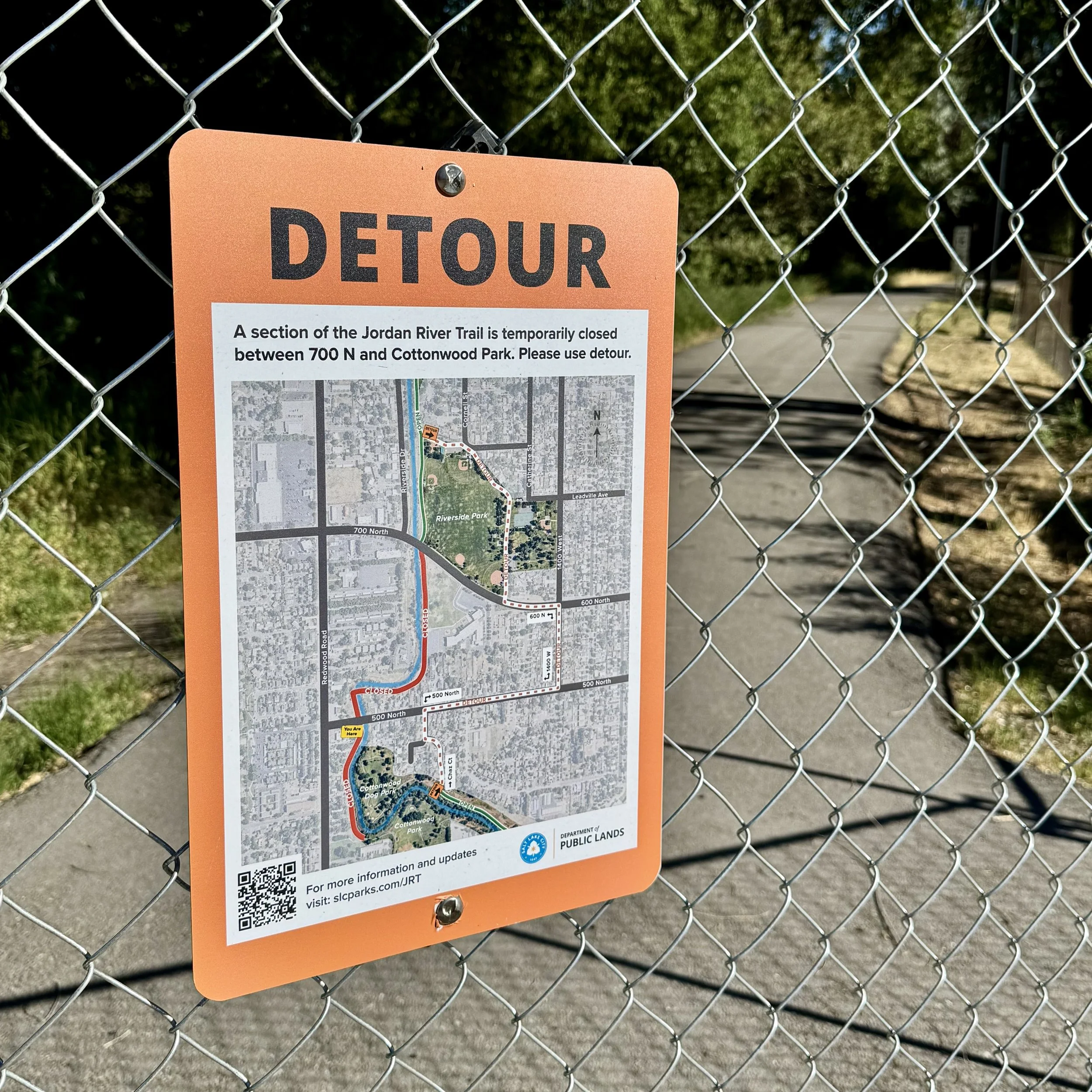
Part of the Jordan River Trail has been closed indefinitely while city officials and law enforcement try to reduce crime and make the area safer. Photo by Andy Cupp.
One of the 27 action items listed in the Salt Lake City Public Safety Plan lists the Jordan River Trail as being a key hotspot where “the city knows people are illegally using, processing, or distributing narcotics,” and has linked these disturbances to those experiencing homelessness. As such, the city plans to utilize its Violent Criminal Apprehension team to aggressively disrupt the spread of narcotics and firearms, which ultimately translates to an increase in police presence along the Jordan River Trail.
In conjunction with the Public Safety Plan, the city has also announced a temporary closure of a section of the Jordan River Trail between Cottonwood Park and 700 North. It is expected to remain closed for several months while city officials and law enforcement focus on reclaiming the public spaces and disrupting illegal activity, making the areas safer in the long-run. A detour plan is already in place between these locations:
Jordan River Trail at 800 North
800 North to Catherine Street
Catherine Street to Leadville Avenue
Leadville Avenue to 1400 West
1400 West to 500 North
500 North to Montgomery Street
Montgomery Street to Chaz Court
Chaz Court to the Jordan River Trail
An estimated completion date for the Jordan River Trail Project has yet to be announced and the city is hopeful that it will improve feelings of public safety. One thing that seems fairly clear though is that folks living on the Westside can expect to see an increased police presence, especially in areas housing the Jordan River Trail.
New police chief appointed, to play major role in Public Safety Plan
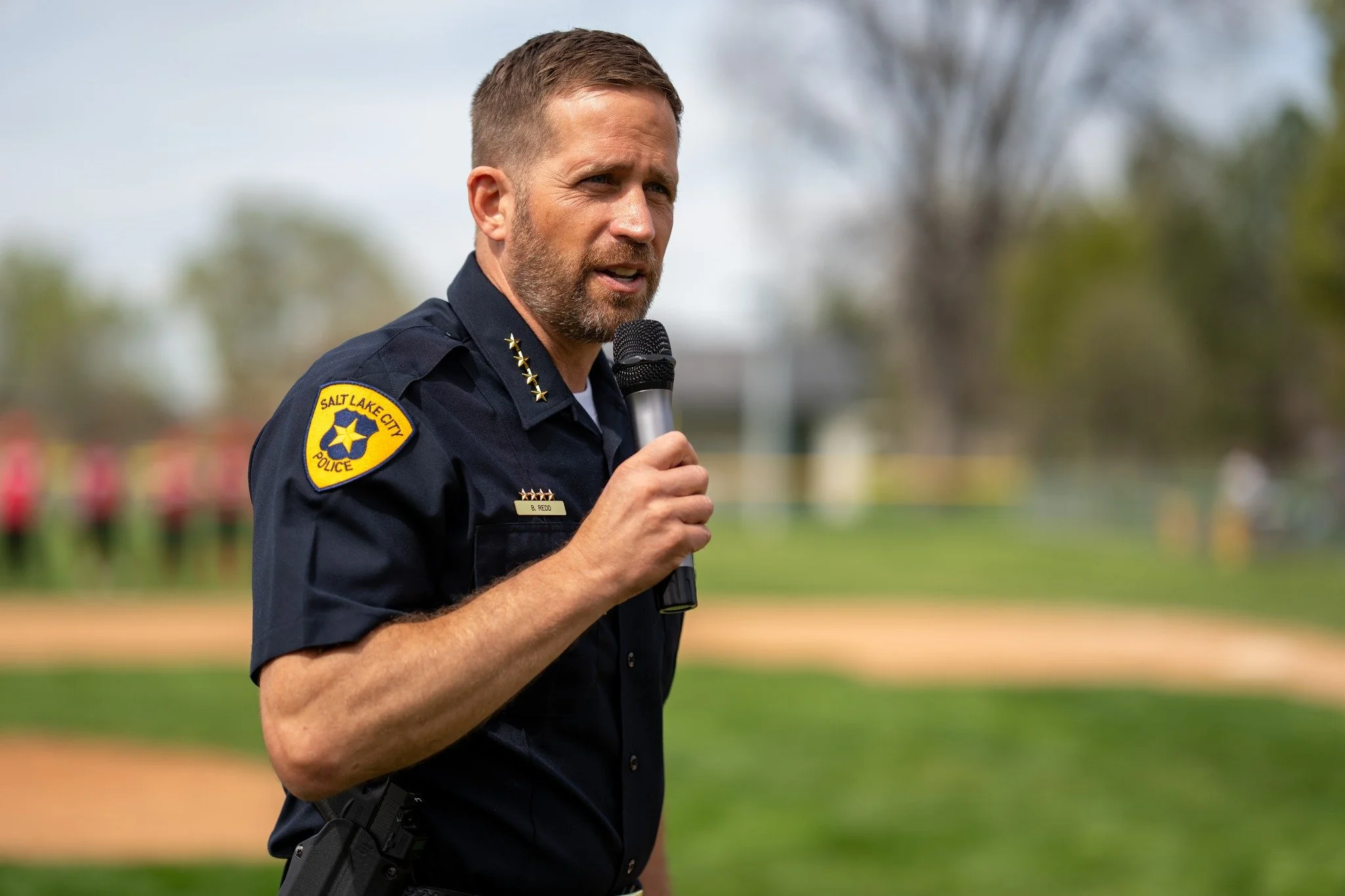
New Salt Lake City Police Chief Brian Redd introduced himself to the Westside during the kick-off of Rose Park Baseball’s 70th season. Photo courtesy of Salt Lake City Police Department.
Shortly after Mayor Mendenhall released the Public Safety Plan and it was revealed that increased collaboration with the Salt Lake City Police Department plays a significant role, Police Chief Mike Brown stepped down and Brian Redd was appointed to lead the department as the new Salt Lake City Police Chief. This change in law enforcement leadership sparked interest and curiosity as to how the new chief will work with the mayor’s office and other community agencies to carry out the Public Safety Plan.
Redd was sworn in as the 47th Chief of Police for the Salt Lake City Police Department on March 5, 2025. Chief Redd has worked with the Utah Department of Public Safety and the Utah Department of Corrections, and has been an advocate for public safety, law enforcement integrity, and community engagement.
Through SLCPD spokesperson Brent Weisberg, Chief Redd shared these thoughts on how the department hopes to support the Westside:
“Living on the streets is neither safe nor humane. Our officers see that reality every day. We continue to prioritize enforcement in areas most impacted by illegal encampments, drug activity, and associated crime. Recent efforts along North Temple have helped reduce calls for service and improve safety, but we’re also seeing individuals shift east, with new patterns forming near Liberty Park and the Ballpark district. The data confirms what many in our community already understand: without real, long-term solutions, enforcement alone can displace problems rather than solve them. Our officers are repeatedly encountering, and arresting, the same individuals in different parts of the city. We’re addressing public safety concerns in one neighborhood, only to see the same issues resurface somewhere else. This effect can only be stopped through stronger coordination with our criminal justice partners. We need accountability at every level, including from the courts and the jail. Repeat offenders cannot be cycled back onto the streets after every arrest. We need them held long enough to allow for meaningful intervention. We also need more shelter space. We are currently exploring opportunities to find dedicated beds specifically for people referred by law enforcement. Our officers are committed to protecting our neighborhoods. We need the entire system to function, not just to respond, but to follow through for lasting solutions.”
Those interested can read the full Public Safety Plan by visiting https://www.slc.gov/publicsafetyplan/.