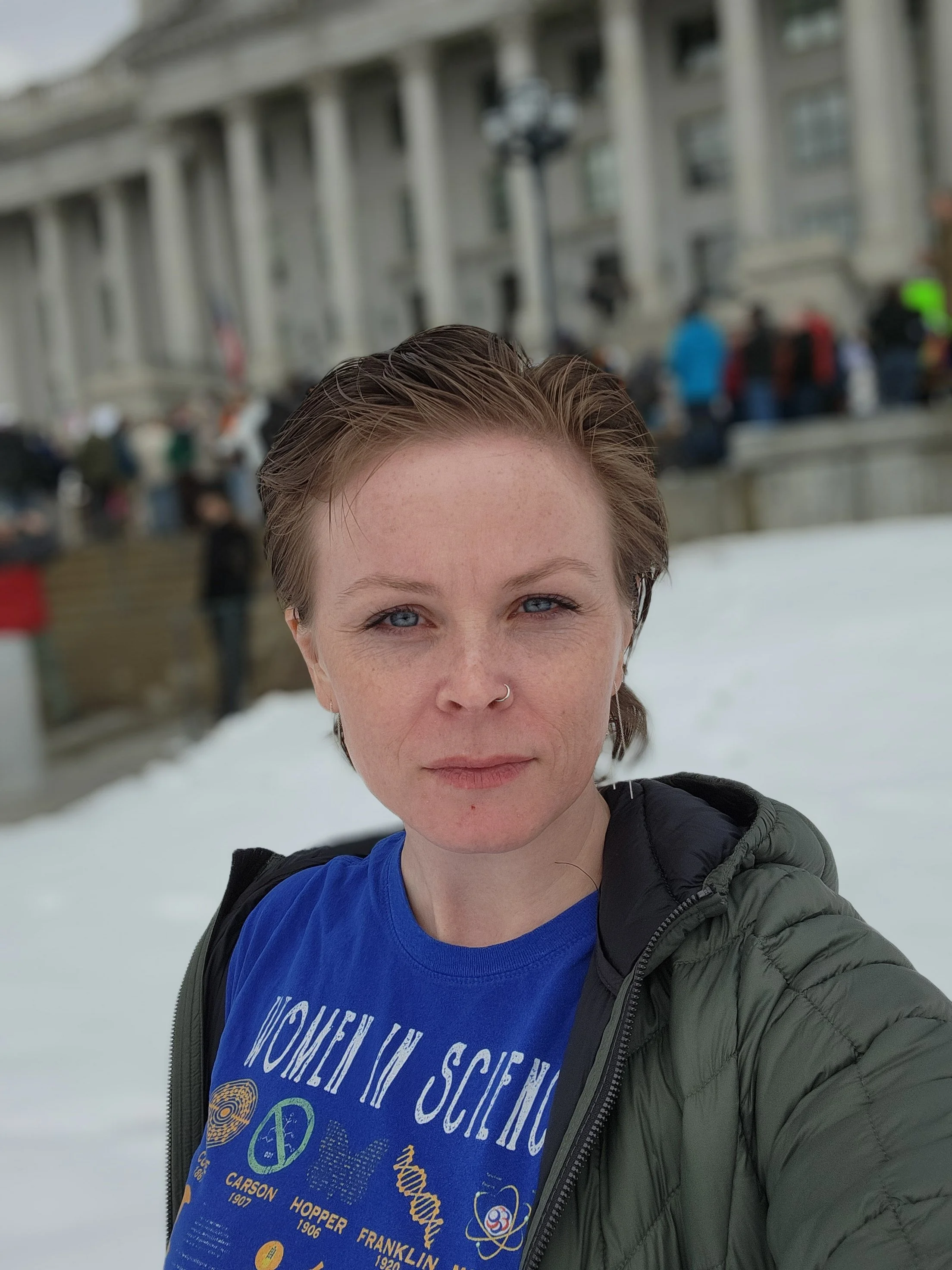
After spending the last several years helping in various capacities on the Glendale Community Council, Jennifer Madrigal has stepped into the role of council chair. Photo submitted.
After nearly a decade of calling Glendale home, Jennifer Madrigal is stepping into a new role that places her at the center of a neighborhood in transition. This year, Madrigal was selected as chair of the Glendale Community Council, a volunteer body that serves as a bridge between residents and city decision-makers in one of Salt Lake City’s largest and most diverse neighborhoods.
Madrigal’s path to the role has been gradual and deeply rooted in place. Born in Orem, she spent much of her childhood in California before returning to Utah to finish school. As she wrapped up her time at the University of Utah, she found herself with what she jokingly describes as “more time” — time that soon became an investment in local civic life.
She began attending community council meetings around 2022, first as an engaged resident, then as an at-large board member. From there, she moved into the vice chair position before taking on the role of chair at the beginning of this year.
For Madrigal, the position is less about authority and more about amplification.
“I want to help elevate the things that are important to our neighborhood residents,” she said. A major focus of her leadership, she explained, will be improving how information flows in and out of the community, making it easier for residents to know what’s happening while also making sure their concerns and ideas are heard.
That work, she said, is inseparable from relationship-building.
“Every person will have struggles and misfortunes at some point in their lives,” Madrigal said. “A close-knit network of neighborly relationships is a safety net that can help any one of us facing struggles and tragedies — not alone, but as a unified community.”
She is also candid about the realities Glendale faces, including a lack of trust among some residents who have historically felt overlooked or underserved. Building rapport, she said, will take time, patience, and consistency, but each step forward matters.
Those challenges are not abstract. Glendale’s geography and infrastructure present real barriers for many residents. The Westside neighborhood is physically boxed in by train tracks to the east, SR 201 to the south, and I-215 to the west. That layout complicates daily travel for work, school, and shopping.
At the same time, Glendale is experiencing an uptick in higher-density housing development, raising questions about whether transportation, education, and commercial infrastructure can keep pace.
Despite its size, Glendale has just one full-service grocery store within its boundaries. Much of the neighborhood is classified as low-income or low-access to food under federal standards, and walkability remains a persistent concern. For families living on the eastern edge of the neighborhood, students must still travel more than four miles to reach their designated public high school — a burden Madrigal says disproportionately affects children and working families.
“Improving access to resources while at the same time taking on increased housing density is something that needs to be proactively done,” she said.
Still, Madrigal is optimistic about what lies ahead.
She points to Glendale’s cultural and ethnic diversity as one of its greatest strengths, and sees upcoming projects as opportunities to reflect that richness in public spaces. Planned and ongoing investments include the development of the Glendale Regional Park, a redesign of Jordan Skatepark, and renovations at the International Peace Gardens. She credits former council chair Turner Bitton (who also moonlights as Executive Director of The West View) with laying much of the groundwork for those efforts.
Another major opportunity, Madrigal said, is the transformation of Riley Elementary into a career and technical education center offering high school classes. The shift could significantly reduce transportation challenges for students in the neighborhood. She noted that Salt Lake City School District Superintendent Elizabeth Grant has actively invited neighborhood input as plans move forward.
Programs like the city’s Love Your Block grants and annual Capital Improvement Project funding rounds also give residents tangible ways to shape their surroundings — from small beautification efforts to larger infrastructure upgrades.
“Change is here and it’s not slowing down,” Madrigal said. “Now is the time for us to lift up the voices of our neighbors to shape the future of Glendale according to the needs of its residents.”
Her message to the community is both direct and hopeful.
“Times have been difficult in many ways, but we are resilient, and always stronger together,” she explained. “We are all neighbors, and should all feel welcome to take an active part in our larger Glendale community.”
That invitation extends beyond formal meetings. Madrigal emphasized that community building often starts small; in something like a shared meal, extra vegetables from a garden, or even a wave and a smile. For those looking to engage more formally, the Glendale Community Council meets on the third Wednesday of every month at 7 p.m. at the Glendale Branch Library, with meetings also recorded and posted online.
And for residents who feel unheard or unsure where to start, Madrigal offered a simple directive: reach out. “If you ever feel unwelcome, unheard, or otherwise blocked from participating,” she said, “come talk to me at a monthly public meeting.”
As Glendale navigates growth, constraints, and opportunity all at once, Madrigal’s approach is grounded in a belief that lasting change begins with connection — neighbor to neighbor, voice to voice.
