
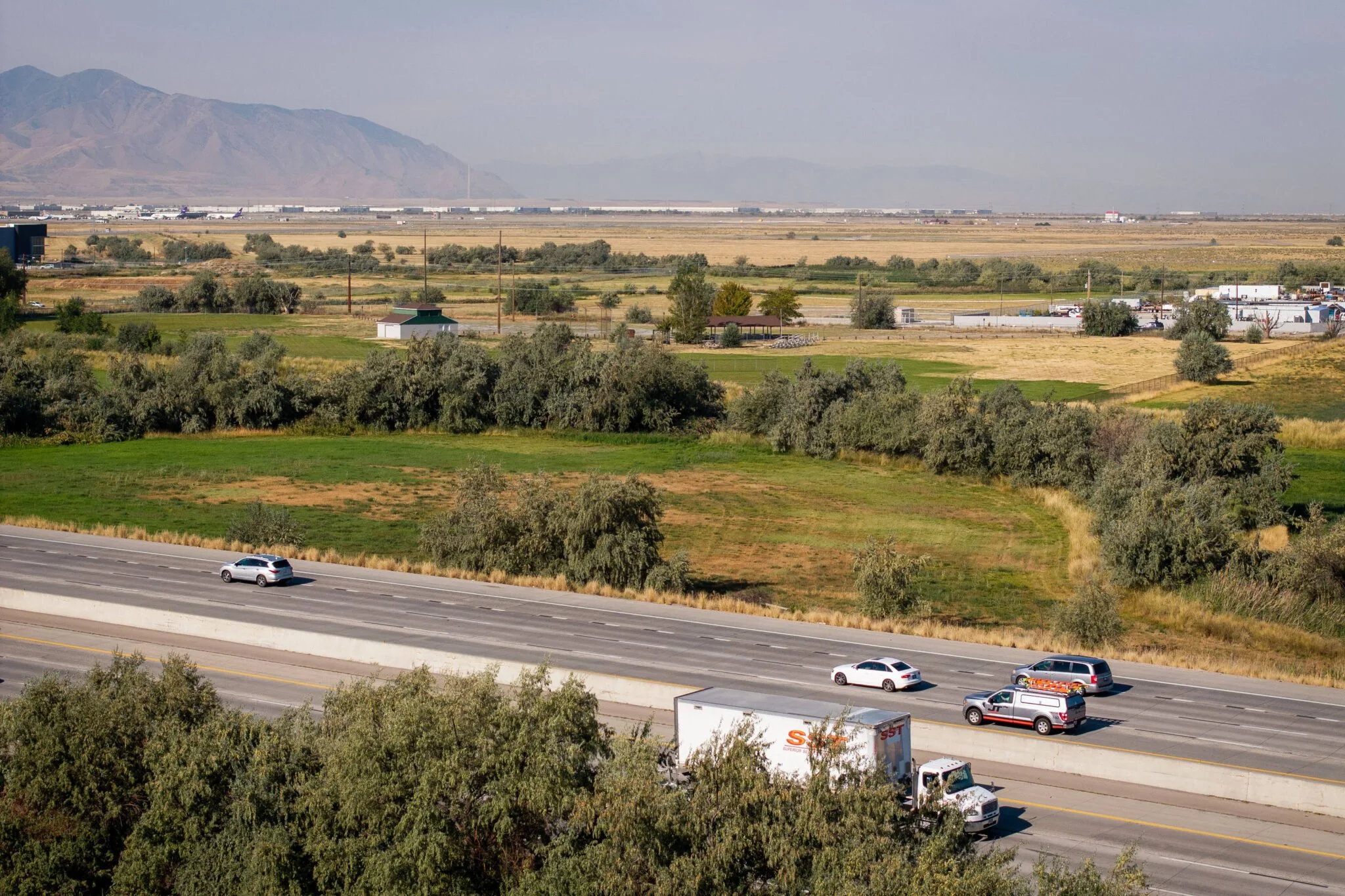
The site of a future homeless services campus at 2520 N. 2200 West in Salt Lake City is pictured with I-215 in the foreground on Wednesday, Sept. 3, 2025. Photo by Spenser Heaps for Utah News Dispatch.
Rep. Casey Snider’s bill would prohibit state officials from using funding to build a homeless shelter larger than 300 beds. He says land swap ‘commitments’ to buffer the Great Salt Lake haven’t been kept
One of the Utah House’s top Republican lawmakers dropped a surprise bill on Monday that he said is his response to frustrations over broken promises to create a larger buffer zone around the Great Salt Lake.
House Majority Leader Casey Snider, R-Paradise, is sponsoring HB523. If approved by the Utah Legislature, it would prohibit the Utah Office of Homeless Services from spending any money to “establish a large-scale, low-barrier shelter” that’s 300 beds or bigger.
It would also repeal a provision of state law he sponsored last year that granted the state eminent domain powers to condemn an unincorporated property owned by Salt Lake City for “constructing a new facility on the land for homeless services.” At the time, Snider said it was meant to enable the state to break a conservation easement on that property so a homeless facility could be built.
The bill however, specifies that the office could still spend money to build a “temporary emergency shelter.”
Snider told reporters in a media availability Monday he filed his bill in response to “some inaction that I believe was committed to the long-term sustainability of the Great Salt Lake.”
Snider said during discussions with Salt Lake City and private land owners on potential properties for an envisioned 1,300-bed homeless campus, land swap “commitments” were made in order to increase a buffer zone around the southeast side of the Great Salt Lake in exchange for the state using eminent domain powers to clear the way for the homeless campus.
“We had some long-term discussions about what we were going to do permanently around the Great Salt Lake, and there were some exchanges and commitments made,” he said. “Unfortunately those haven’t been followed through at that level, local level.”
House Speaker Mike Schultz, R-Hooper, threw his support behind Snider, saying there’s a “gap” on the southeast side of the Great Salt Lake “that is still unprotected.”
“There are still another few hundred acres that need to be worked out in order to protect encroachment upon the Great Salt Lake,” Schultz said. “That’s the overall goal that we’re trying to achieve as a state.”
Snider said he’s “not comfortable” allowing the state to use eminent domain powers to overturn a conservation easement on a city-owned property while also not enacting conservation protections on other lands to create a larger buffer zone around the Great Salt Lake meant to protect it from encroaching development.
“If we’re not going to have an honest conversation about preserving that corner and moving forward with conservation, I don’t want to be party to that,” he said. “I don’t want to be committing to breaking a conservation easement … if we’re not going to move forward with (other land exchanges.)”
Snider didn’t offer many specifics about who broke land swap commitments, but he said Salt Lake City officials have been involved in discussions and are aware of the issue — though he also noted he’s had “good conversations” with city officials and they’re “rapidly moving in the same direction.”
When pressed, he said the Ivory Foundation — a nonprofit founded by Utah’s largest home builder, Clark Ivory — has also been involved, along with “a few other” partners.
Requests for comment to Ivory and the foundation were not immediately returned Monday.
Salt Lake City Mayor Erin Mendenhall’s office said in a prepared statement that the city’s leadership “has long identified additional shelter, services, and funding as critical needs for the homeless services system.”
“We will continue to work in partnership with the Office of Homeless Services to find solutions that protect our community members, improve public safety, and help the unhoused,” the statement said.
While insinuating that some partners haven’t held up their end of the deal, Snider also left the door open to more negotiations.
“At the end of the day, I just hope everybody is good to their word,” Snider said. “I’ve made a lot of good deals, especially in a small town, on a handshake. And I would like that commitment to be honored.”
When asked if his bill is a “threat,” Snider balked.
“Look, I’m not going to do one thing if people aren’t going to follow through,” he said.
In September last year, state officials announced they were under contract to purchase a nearly 16 acre Salt Lake City-owned property on the city’s northwest border for the purposes of a 1,300-bed homeless campus.
Since then state officials haven’t closed on the property, though they remain under contract.
Snider’s bill could potentially derail progress on the large proposed campus — a project Gov. Spencer Cox has advocated for.
However, top homeless leaders under Cox’s administration told Utah News Dispatch last week they’re focusing their budget requests to lawmakers this year on “high utilizer” programs that can be enacted now, meant to better help people who repeatedly cycle in and out of jails and the homeless system.
Those “high utilizer” programs, if successful, are also meant to inform programming for the future homeless campus, which will likely take multiple years of investment before becoming a reality.
Even if Snider’s bill passes, those efforts could continue — along with investment in a smaller, up-to 299-bed temporary facility.
However, it would also block the ability of the state to use eminent domain powers to free up wetlands on the property currently locked up by a conservation easement, blocking state leaders’ ability to build a larger campus as previously envisioned.
Snider, however, said he’s open to backing off from his bill if land swap negotiations progress.
“We should continue to have discussions and make sure that everybody’s being transparent through the whole process,” he said. “If we resolve these other issues I can resolve my bill.”
This story is re-published under Creative Commons license CC BY-NC-ND 4.0. The original can be found on Utah News Dispatch’s website.