
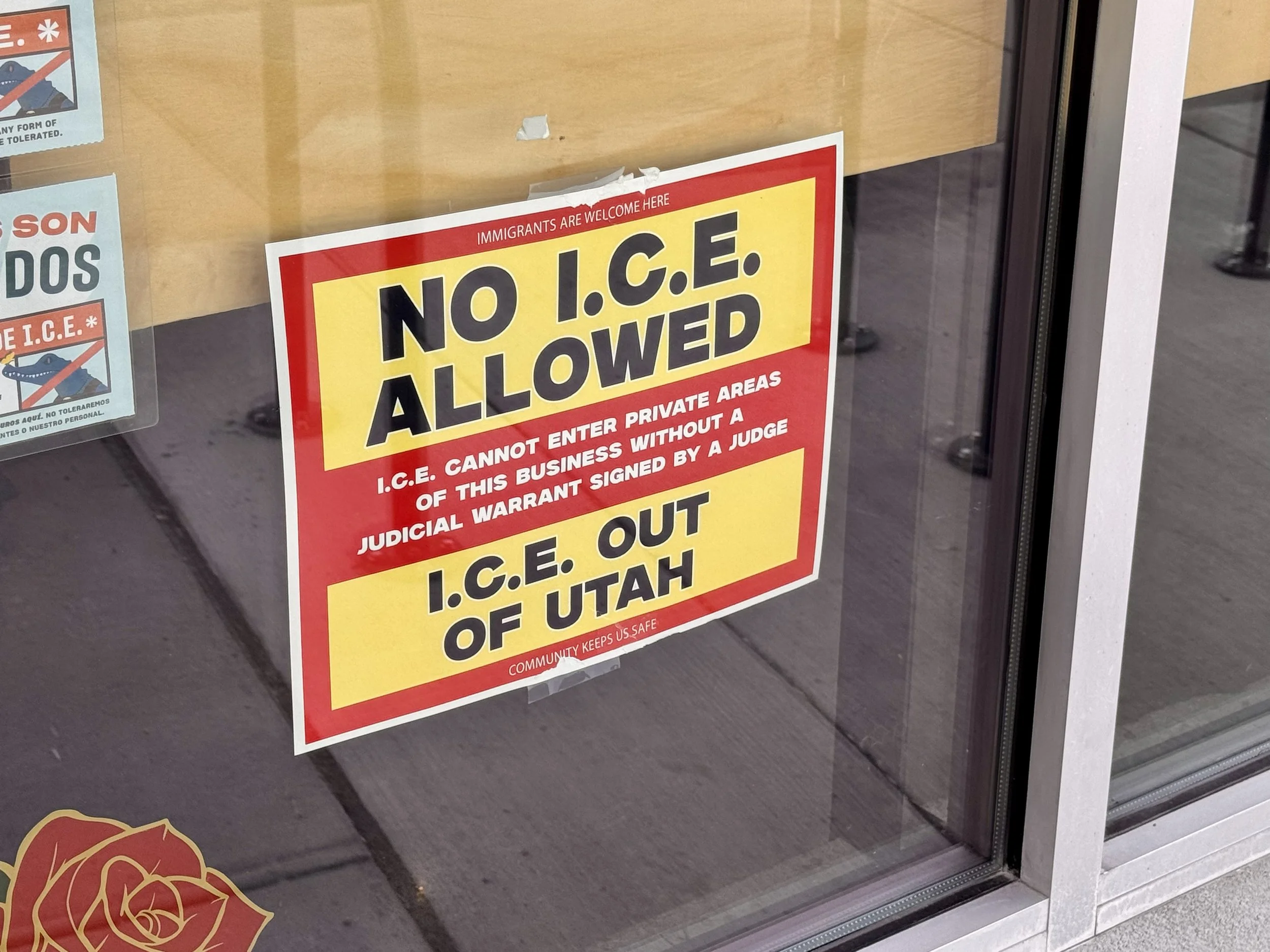
Businesses around the Westside — like Culture Coffee (pictured here) — have begun posting signs barring ICE from entering. While they are limited in their legal rights, the posters act as a kind of solidarity from businesses who support the immigrant population. Photo by Andy Cupp.
If you’ve walked down the streets of the Westside recently — visiting a local business or shop — you may have noticed red and yellow signs on windows and doors reading “No ICE Allowed” or “ICE Out of Utah.” At first look, they may seem like simple statements. But each sign represents an act of solidarity, community organizing, and resistance — all rooted in the real fear that many immigrant families are facing every single day.
These signs came to be as the result of united efforts by local organizers, immigrant advocates, and business owners who are responding to an overwhelming fear that continues to spread in our communities thanks to escalating immigration enforcement.
Immigration and Customs Enforcement, better known as ICE, is a federal agency created under the Homeland Security Act of 2002 following the 9/11 terrorist attacks. Its stated mission centers on national security and the enforcement of immigration laws. However, since President Donald Trump began his second term in office, community leaders argue that ICE’s practices have gone farther than ever before.
For many, the presence of these ‘anti-ice’ signs represent safety, awareness, and the reassurance that they are not alone.
Brianna Puga, lead organizer at Comunidades Unidas (a West Valley City-based immigrant advocacy group) explained that the signs are much more than decorations — they are tools that were intentionally created for a time such as this. Comunidades Unidas, along with other organizers, have a precise vision of what the message on each sign is meant to do.
In recent years, Puga says ICE has acted with increasingly aggressive tactics: entering homes without judicial warrants, breaking car windows, tackling individuals to the ground, and using chokeholds, which are officially banned by the Department of Homeland Security (DHS). These tactics include workplace raids, masked agents roaming local communities, racial profiling, violent detentions, targeting protestors and observers, and family separation — the list goes on.
“ICE’s actions have expanded far beyond their stated mission of targeting criminals,” Puga said. “We are seeing how entire communities have been and are affected now. It is heartbreaking that people are living in fear just by leaving their homes.”
At least eight people have been killed by federal agents or have died in Immigration and Customs Enforcement custody so far in 2026 — this is eight deaths in less than a month (as of January 30, 2026). Among the most well-known cases are the fatal shootings of Minneapolis residents Alex Pretti and Renee Nicole Good, both 37, by federal agents in separate incidents. These killings have prompted organizers and community members to voice concerns about the use of force and the lack of accountability within federal immigration enforcement agencies.
All this has provoked fear, even among people with legal status. Immigrant communities across the country — and in our own backyard across the Westside, Salt Lake City, and Utah as a whole — have been forced to change their daily routines, avoid public spaces, and live with constant anxiety for themselves and their families.
How the signs came to be
This rise in fear sparked conversations between Comunidades Unidas and Salt Lake City Indivisible, a local civic engagement group. Both organizations talked about how immigrant workers — particularly those in food service, domestic work, and sanitation — often lack access to clear information about their rights. At the same time, many business owners are unaware of their own legal authority when confronted by immigration enforcement.
Comunidades Unidas and other organizers say they saw an urgent need and wanted to equip business owners with tools to protect their employees and understand the true legal boundaries of ICE enforcement.
“Business owners have rights, and a lot of them don’t know that,” Puga explained. “The same way they can deny service, they have the right to deny ICE entry without a judicial warrant.”
These efforts aligned with the Salt Lake County Immigrant People’s Agenda Campaign, which launched in October 2025. Through business canvassing and community education, organizers began distributing materials and discussing ways businesses could show support. It was through this work that the anti-ICE signs were created and started to circulate throughout the area.
“We kind of created the sign on the spot,” Puga said. “We had canvassing to do at a local shop [where] we brainstormed ideas, and our arts and culture committee got the sign together. We gave it to one business, and then we just started getting requests from other places. We never imagined it would take off like this.”
To date, organizers have distributed more than 650 signs across Utah, including various locations in Salt Lake City, Utah County, and Cache County.
The anti-ICE signs serve both symbolic and practical purposes. Symbolically, they communicate solidarity. They tell workers, customers, and neighbors that a business stands with immigrant communities and is willing to take a public stance against fear-driven enforcement. “It lets people know, ‘You’re not alone. And we will do what we can to know our rights and protect you,’” Puga said.
As pillars of the community, local businesses symbolically embody both the power of collective action and the courage required to confront systemic fear.
On a practical level, the signs show that a business owner has taken steps to educate themselves about immigration enforcement policies and their legal rights. When businesses receive a sign, they are also given Know Your Rights materials, including clear examples and guidance on how to identify different types of warrants and how to respond to ICE encounters.
Knowledge is power
Organizers are clear about the signs’ limitations. “The signs themselves aren’t a shield. But they’re a starting point,” Puga said. “They signal that this business is informed, prepared, and [standing] in solidarity with the community. That’s how we make an impact.”
According to Puga, ICE can only enter business premises if agents present a judicial warrant signed by a judge; the signed document gives them legal authority to search or detain. But without one, business owners have the right to refuse entry — a distinction many may not realize. Organizers behind the anti-ICE signs emphasize that this knowledge is what gives the signs meaning.
“The sign holds legal weight when the owners are informed. Knowledge of these rights is crucial in a time like this,” Puga shared. “Knowledge holds power.”
It’s also important to note that businesses displaying these signs do not hold a kind of sanctuary status often found in churches and schools. The signs provide solidarity and information, but an undocumented immigrant may not use the signs as a shield to hide in a business. According to the Catholic Legal Immigration Network, “The Immigration and Nationality Act (INA) prohibits individuals from concealing, shielding, or harboring unauthorized individuals who come into and remain in the United States.” This would also apply to private businesses even if they have posted an anti-ICE sign.
As has been reported many times in the past several months, ICE agents have relied on and taken forceful action, entering public spaces and business locations in ways that disrupt daily life and commerce. Federal agents have conducted arrests at workplaces and retail spots — from big corporate stores like Target and The Home Depot, to local neighborhood shops and restaurants. These actions have shaken communities, pushed customers and workers away, and continue to affect local economies and people’s sense of safety.
On the Westside, the signs hold even more significance, largely due to the demographics of the people who own or frequent businesses in the local community. Many immigrants work in service industries, putting them on the front lines of public interaction; increasingly, that means a greater likelihood of interactions with federal enforcement. At the same time, small businesses hold significant economic and social power within their neighborhoods.
By choosing to display a sign, business owners are making a conscious and voluntary decision, one that can also carry risk. “Putting up a sign is a huge risk in itself, especially right now,” Puga said. “Fear is hurting businesses too.”
Organizers behind the movement acknowledge the risks involved with displaying the signs, especially since ICE agents continue to operate against regulations. Businesses may become more visible targets for enforcement or face backlash from those who don’t understand the critical chaos their neighbors are living day-to-day.
While the signs cannot prevent aggressive actions, organizers emphasize that documentation is critical in these situations. Businesses and community members are encouraged to record dates, times, badge numbers, and interactions whenever enforcement occurs, creating evidence that can support accountability and legal action.
“Documentation is one of the strongest tools we have,” Puga said. “This creates evidence for legal recourse and contributes to long-term accountability and community awareness.”
More than just displaying a sign
Organizers and community leaders are not just focusing on displaying signs; they’re also encouraging participation in Know Your Rights training, neighborhood organizing, and conversations with neighbors and family members. By sharing knowledge and mobilizing, community members extend the impact and help build resilience and power.
“The minute we start talking to each other, that’s when power starts to grow,” Puga said
The anti-ICE signs reflect shared values: solidarity, education, and collective action. The signs have also ignited a movement rooted in human rights, community safety, and resistance to an unaccountable agency operating through fear, secrecy, and excessive force.
They serve as visible reminders that local businesses are not just an establishment of purchase, but spaces where community protection and resistance can take place.
These coordinated efforts send a clear message: communities are not alone, and people refuse to stay silent. They demonstrate that the Westside will stand together, supporting one another — one business at a time.