

A new homeless campus coming to the Westside will act as a “hub-and-spoke” system, providing a range of services for Utahns experiencing homelessness. It won’t replace any existing systems of support, but will be designed to complement those resources. Rendering courtesy of the Utah Office of Homeless Services.
State officials have announced the acquisition of land in a more rural part of Salt Lake City’s Westside to be used for a major homeless campus. The announcement was made on the morning of Wednesday, September 3rd.
The 15.85-acre plot of land — which sits just off I-215 north of 2100 North — backs up to the freeway in an area filled with farmland, marshlands, and warehouses. Officially located at 2520 North 2200 West, it will be designed to house approximately 1,300 beds, creating a space state officials say will provide a “sustainable and transformative solution to address homelessness in Utah.”
State homeless coordinator Wayne Niederhauser says the campus won’t just be a shelter, but a “comprehensive hub” where Utahns experiencing homelessness can go to receive support and treatment. The goal, according to Niederhauser, is to help people move away from homelessness and into stability and “long-term self-reliance.”
“This is more than a campus, it’s a turning point for Utah of reimagining hope,” said Niederhauser in a press release. He also noted that state officials debated many locations throughout the state before settling on the proposed location.
The campus, which Neiderhauser aims to one day expand to over 30 acres, is designed to work in tandem with existing homeless shelters and service providers throughout the state; it won’t be a replacement for those services. The campus will offer services for recovery, employment, criminal justice assistance, and housing.
The Utah Office of Homeless Services says the campus will operate as a “hub and spoke” system where “individuals can Step In to access core services at a centralized hub, and once stabilized and ready to Step Up, they can Step Out to be connected efficiently to additional specialized resources across the community—the spokes.”
State officials say the model will reduce barriers for assistance and increase collaboration between the various support networks and systems already in place around the area.
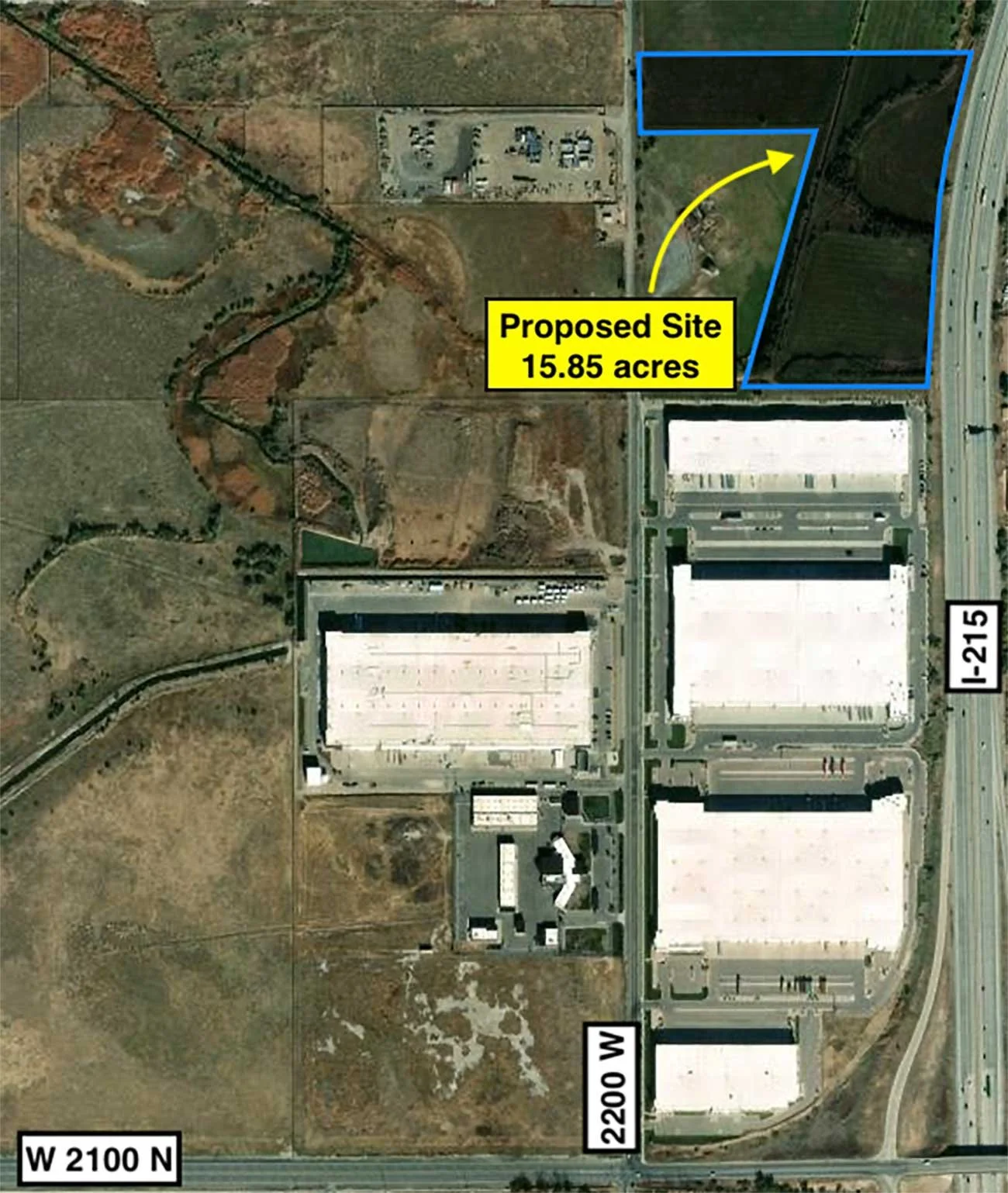
State leaders say they’ve signed an agreement to purchase roughly 16 acres of land on Salt Lake City’s Westside to build a 1,300-bed campus to provide shelter, treatment, and other resources for Utah’s homeless community. Map courtesy of the Utah Office of Homeless Services.
“Despite tremendous effort, resources, and goodwill across the state, homelessness in Utah has continued to worsen — for both those experiencing it and for our communities,” said Randy Shumway, chair of the Utah Homeless Services Board. “The proposed Utah campus will take a human-first approach that provides healing and stability while embedding accountability at every stage.”
“By providing consistent shelter and wraparound services in one location, this facility could also help Salt Lake City first responders by reducing the number of emergency calls, freeing up law enforcement to focus on public safety, and better connecting people to the help they need,” said Salt Lake City Mayor Erin Mendenhall.
Niederhauser says the state reviewed several dozen other properties around the state but eventually settled on the proposed location. While just less than 16 acres now, he says they hope to acquire neighboring properties as well, with the goal of expanding the campus to be at least 30 acres.
Local and state leaders, members of the public respond to plans
Immediately following the announcement, State Senator Luz Escamilia and State Representative Sandra Hollins released a joint response, expressing concern with the plans, writing in part:
“With the Utah Homeless Services Board’s proposal of a new homeless services campus in the area we represent, we are concerned that this decision was made without any significant input from the public.
“Our community has always been committed to helping those in need; it is central to who we are, and we are proud of this. At the same time, this neighborhood has historically carried a disproportionate share of the state’s social and environmental burdens. The relocation of the state correctional facility here is one example. Now, with the addition of a 1,300-bed homeless services campus, the [Westside] is once again being asked to carry a disproportionate share of the state’s response to homelessness.
“We urge the Office of Homeless Services, the Board, and Salt Lake City to move forward with care and foresight, guided by a clear and comprehensive plan that addresses transportation, public safety, and the well-being of both campus residents and the surrounding neighborhood. If done thoughtfully, this project can meet urgent needs while respecting and strengthening the community that hosts it.”
In a meeting held the night of the announcement at the Day-Riverside Library in Rose Park, residents expressed several concerns, ranging from public safety to a lack of transportation options in the area. Many residents of Rose Park and neighboring areas also worry about public spaces and schools being impacted as they would directly fall into the path of homeless individuals transitioning from Downtown to the new campus.
Currently, the area possesses no public transportation; people can get to this proposed location via car only. Niederhauser says right now, the state utilizes a shuttle system to get people experiencing homelessness various services and that that shuttle system would be expanded to provide access to this campus. However, many residents believe that this kind of system would be difficult to expand enough to accommodate 1,300 people.
During the community meeting, Salt Lake City Councilmember for District 1 — which covers this particular area — Victoria Petro apologized to the audience of nearly 100 people, saying she knew about the plans but wasn’t able to warn constituents ahead of time.
“I should have violated closed-session law,” Petro told the crowd. “I should have taken the misdemeanor, and I should have told you sooner, but I didn’t. But this is what we can do now.”
Councilmember Petro explained that these plans had been discussed in closed-door meetings. According to Utah State Code 52-4-305, “a member of a public body who knowingly or intentionally violates … any of the closed meeting provisions of this chapter is guilty of a class B misdemeanor.”
Some state lawmakers expressed gratitude for the plans and hope that they would be successful, while also expressing concern that — without full cooperation from everyone involved — the plans would fail.
“To succeed, this new campus must offer more than just shelter; it must deliver real accountability through treatment, recovery, and long-term stability, or it will fail like every half-measure before it,” said Utah House Speaker Mike Schultz.
The plans still have quite a ways to go, but the state is hoping to move quickly. Already, a feasibility study has been conducted and environmental studies are currently underway. The Utah Office of Homeless Services will now work to secure funding and engage with stakeholders who will be involved in the process and implementation, including community members and leaders, service providers, and state leaders.
The state hopes to get the campus up and running in 2027.
To get updates on the project and to learn more information on the plans and the processes — including in-depth looks at how this “hub and spoke” model works — visit https://homelesscampus.utah.gov/.
