
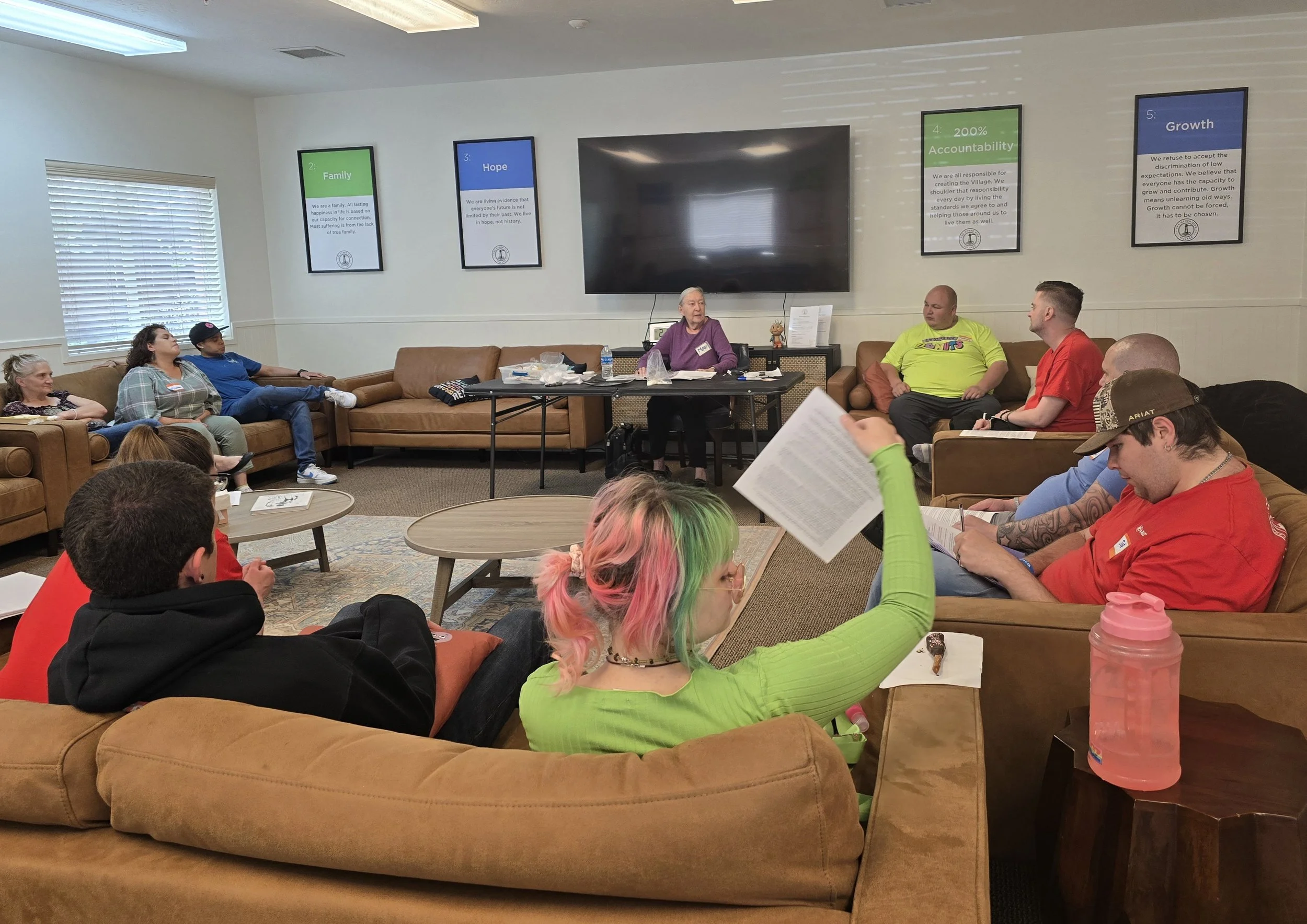
Mary Young, who is a teacher, artist and chocolatier, talks to Prep School students about handling difficult emotions, part of an eight-week course she specifically designed especially for them.
The Other Side Village (TOSV), an all-inclusive living community for the chronically homeless, is currently receiving residents. But before gaining access to one of 60 cottage homes in the first phase of development, future residents are required to attend at least six months of training at The Other Side Village Prep School.
Through TOSV Prep School, those enrolled learn a new way of thinking using a human first, whole person framework that emphasizes self-love, self-trust, accountability, solidarity, community, unlearning negative beliefs, mentoring, self-reliance and honesty. The framework was first developed during the COVID-19 Pandemic to emphasize social-emotional needs and bring attention to mental health.
The TOSV Prep School is an interim and much-needed experience that helps prospective residents transition from homelessness to moving into a village home.
The program provides intensive growth and healing in a democratic, therapeutic community centered around peer-led accountability. “It’s a supportive environment with mental and physical health services, and meaningful group interactions,” said TOSV CEO Preston Cochrane. It's in this sober-living residential space that future village residents learn about a peer-driven culture and better understand what village life will be like. The Prep School eases the transition to a healthy lifestyle of independent living and to being an active part of an inclusive, clean, sober, and connected neighborhood.
“If (homelessness) was just a matter of providing a place to live, then this epidemic would’ve been solved a long time ago,” Cochrane added. “People coming into the school have many things to overcome. They feel alone and overwhelmed and have difficulty asking for help, but they also have a strong desire to improve and a strong will to succeed. Their resiliency is incredible.”
Upon arrival at the Prep School, students commit to a lifestyle of honesty, accountability, sobriety, and participation. This includes responsibilities like contributing to daily operations (cooking, cleaning, planning and cooking meals, etc.) of the Prep School, attending groups, engaging in peer support, and actively working on personal development.
“Enforcement is handled through peer accountability. The community itself plays a central role in upholding the standards we live by. Rather than a top-down punitive approach, we use a peer-driven model of correction and support—helping each person reflect, learn, and recommit when necessary. It’s part of how we build deep trust and real change,” said Cochrane.
It’s in the Prep School where people who have been experiencing homelessness learn new — more positive and productive — ways to think and live. It’s where they stabilize from the streets and establish healthy relationships with a therapist, a caseworker, and with others in the village community.
Currently, there are roughly 20 students in The Other Side Village Prep School. As they graduate to The Other Side Village community, new students join the Prep School to start their journey of transformation.
Mathew’s story
Mathew Evans, who has completed his Prep School hours and now resides in the village, had been living on the streets for approximately 10 years. “I didn’t care about anyone including myself and had a lot of hostility and a long-term drug habit,” he said.
“After getting sober I went right into the Prep School and started the process of getting to know myself as a sober person. I learned that I’m a strong person who can set goals and have a better life. I learned how fulfilling it is to work within a community with like-minded people. It’s like coming into a family and changing from a taker’s mind set into a person with integrity, honesty and compassion. To get off the streets you have to be willing to change who you are and develop into a person who cares about self-reliance and becoming a member of a shared community. Every person who wants a better life off the streets has to take this journey of self-discovery, discipline and having meaningful relationships,” he added.
As one of the first occupants in the village, Mathew now serves as a role model and inspiration to others. He now helps others with the transition from the Prep School to the village and has employment at The Other Side Donuts.
Alan’s story
Alan Hepting just moved to a Village home after spending eight months in the Prep School. He had been on the streets or prison most of his adult life. He says he had a great family growing up but just got in with the wrong crowd. When Alan expressed interest in going to the Prep School his enrollment was problematic because there was a warrant out for his arrest for skipping out on probation. After getting this straightened out, the management of The Other Side Village told him he might have trouble getting through The Other Side Village vetting process because his crimes included brutal assaults.
Because the Prep School is based on self-governance, it’s the students who decide if someone is ready and able to make the necessary changes, said Cochrane. With Alan there was some concern because of the nature of his crimes. But his honesty and willingness to do whatever it would take to turn his life around convinced the group to give him a chance. In fact, it speaks volumes about the self-governing nature of the Prep School in that anyone – no matter their past – who is willing to make the commitment gets voted into the program.
After being accepted into the Prep School, Alan says he went from being a taker on the streets to being an accountable, trustworthy giver. He serves as a mentor to others in the program and has a job at The Other Side Village Freeze-Dried Packing Plant where he has worked his way up to department head.
“The Prep School saved my life. Being accepted by the community and then becoming part of the community makes a big difference for people who have burned all their bridges and hit rock bottom. We all have to learn how to live in society. I was like a feral cat. The people in the program and the coaches are very supportive but each individual has to put in the work to change their thinking patterns. It’s so rewarding to make these positive changes and to watch others do the same. Because of this opportunity I’ve been able to let go of my past and become a happy, caring, productive and supportive person. This is a big change, and it feels great!” he said.
Holly’s story
Holly Brown (using an alias because she has children who need protection) has been in the Prep School for just over six months. She became a single parent when her now ex-husband went to prison for child molestation. She had seen all the signs, but no one would believe her, including her family and church officials. She explained that she grew up in a controlling religious family and then married a controlling and abusive religious man.
“In both households I was treated like a second-class citizen because I was a woman. Mental illness in both households was equally distributed but always denied or ignored. Crying or the showing of any emotion was prohibited. I was shamed if I did something wrong and never allowed to express my opinion. I had a lot of responsibility at a very young age and became a people-pleaser who always did things for others, never myself,” she said, about her upbringing and her marriage.
When the police finally arrested her ex-husband, Holly tried her best to support her children on her own and was able to do so for five years. After that, things started going wrong and quickly spiraled downward.
“I was already dealing with anxiety and depression and then I had a bout with psychosis,” she said, explaining that it was during this time that children went to live with their grandparents and she ended up on the streets.
In spite of her negative environment, Holly had a strong desire to get a higher education. And through the support of friends and counselors she graduated from college with degrees in political science and English.
After being on the streets for more than a year Holly finally received much needed help and encouragement. She also received a proper diagnosis of her mental condition and was finally placed on the right stabilizing medication.
She says of her time on the streets, “I was pretty beaten down but somehow, I found help for myself and my kids… I feel so grateful to be in this (Prep School) program. I’m grateful to know where I’m going, grateful to be gaining confidence. We become what we do.” We show up every day and do what needs to be done. We work together. We help each other. It’s not always easy but it’s our turn to be bold and walk to the front. We walk with purpose and put on a strong face for ourselves and for our community. We make ourselves strong and accountable for ourselves and our community.”
With her degrees and work history Holly contributes many useful skills. She’s currently working at The Other Side Donut Shop. She has also become a role model for others and enjoys being a leader.