
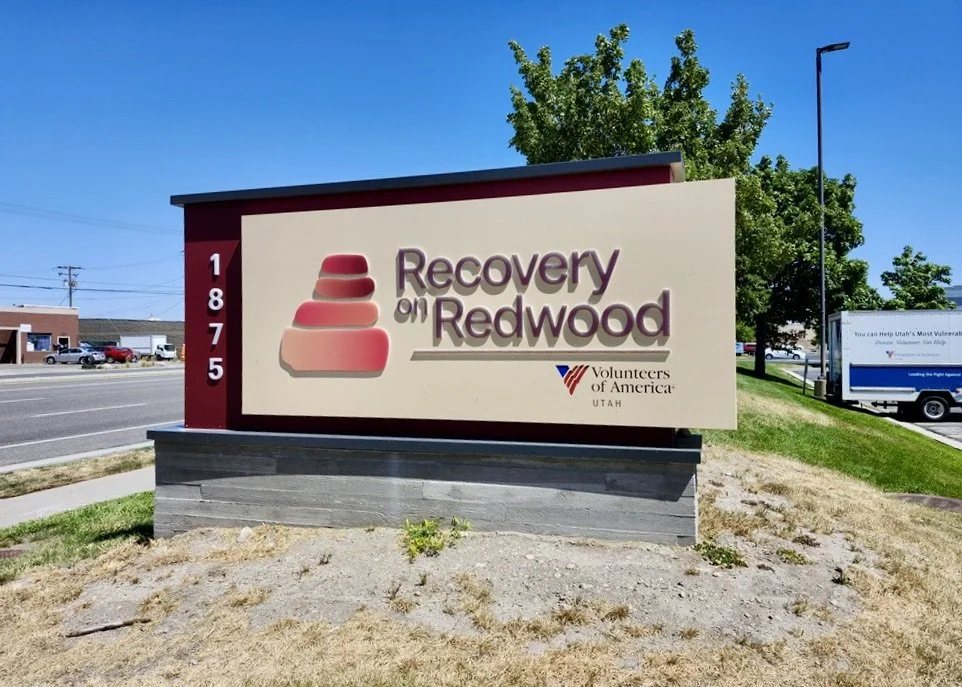
Volunteers of America (VOA) Utah's offices on Redwood Road are among the mental health resources available to West Side residents, although they serve anyone in need of help. Nielsen with VOA said the organization's messaging could improve regarding the services it offers. Photo by Jacob Rueda.
In some parts of Salt Lake City, finding a therapist is as easy as searching online; on the Westside, it’s a different story. A tangle of challenges — from confusing messaging to financial strain — can limit the level of access to mental health services.
The issues regarding access to mental health care for Westside residents are multifaceted. Barriers like cost and limited insurance coverage to fewer nearby providers can hinder availability.
Messaging challenges
One issue that might not be as obvious is awareness. Organizations exist that directly provide mental health services or refer people to those that do. However, their purpose and whereabouts are nebulous at best. Some professionals in the field say this is an area where improvement is needed.
“We've had a lot of conversations recently about how our name is actually really confusing,” said AJ Nielsen, communications director at Volunteers of America, Utah (VOA). Their offices on Redwood Road near 2100 South offer a range of mental health services, including support for those experiencing homelessness, those trying to detox, and those seeking therapy, all with assistance from Cornerstone Counseling.
Depending on where the line between the east and west sides of the city is defined, a number of mental health clinics and resources are available. Although mental health services exist, deciphering who does what can be confusing for anyone unfamiliar with nonprofit PR jargon.
Soft-focus statements and phrases like “reciprocal learning” or “community conveners’ may be easy for some to understand, but for people who don’t speak that way, they raise more questions than they answer.
When organizations’ messaging isn’t clear, people don’t show up. And on the Westside, where trust can be limited, it can mean the difference between getting help and staying silent.
An organization like "Valley Behavioral Health" clearly reflects its focus through its name. They are a nonprofit network of clinics licensed by the State of Utah and are based in Murray.
Meanwhile, "Volunteers of America" is a faith-based nonprofit headquartered in Alexandria, Virginia that “serves people and communities in need,” according to the mission statement on their website. The range of what they do is as varied as their locations throughout the mainland U.S. and Puerto Rico.
However, the word “volunteer” in the title suggests the organization does something like help people during natural disasters, or during a time of social crisis. For many people, it does not immediately conjure “mental health services,” which is actually a considerable portion of what the organization does.
Nielsen said that his chapter of the VOA could do a better job of informing the public about what they actually do. “The whole thing was founded on people coming together to serve vulnerable populations,” he said. The organization also offers volunteer opportunities to assist with serving meals or any other tasks where help is needed.
University Neighborhood Partners (UNP) faces a similar issue. This organization provides a variety of different services and referrals for Westside residents. And while they do not offer mental health services directly, they collaborate with organizations like Latino Behavioral Health to refer individuals in need. However, their messaging does not specifically convey that they do this, making it difficult for people to understand their true function.
A lack of clear communication about available services can further complicate access to care. For those who struggle with physically getting to their appointments, it can be an added burden.
Child and Family Empowerment Services (CFES) operated on the Westside for more than 20 years. Their offices at 1578 West 1700 South were located within a building owned by the University of Utah.
While no longer located on the Westside, CFES continues to provide culturally sensitive care for residents as part of its core philosophy, according to Leilani Taholo, Ph.D., a licensed clinical social worker and the organization’s founder. The clinic also serves individuals on Medicaid.
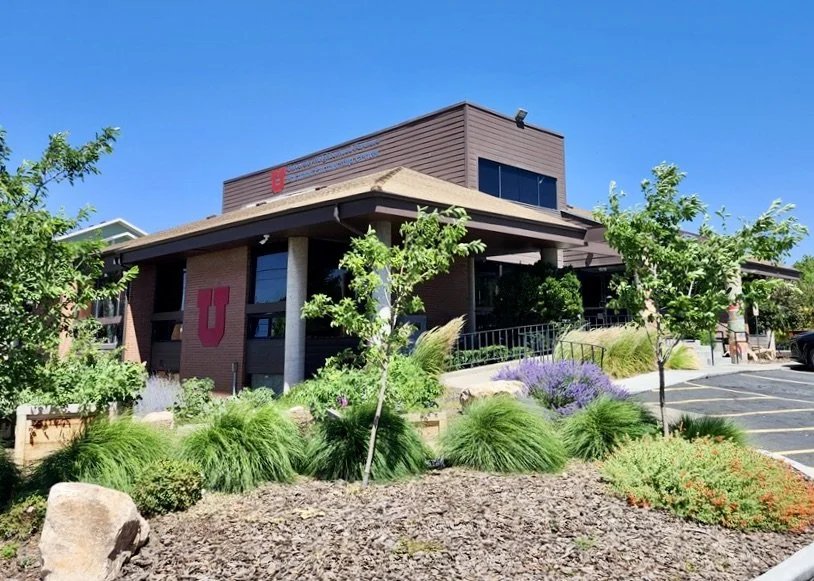
Child and Family Empowerment Services (CFES) was previously located at 1578 West 1700 South. It was one of the few clinics that accepted Medicaid and offered specialized care in clients' native languages. Photo by Jacob Rueda.
In 2023, CFES was forced to leave its Westside location after the University of Utah raised the rent. They have since moved to West Valley City on 4700 South and 2880 West, close to the old DMV offices. During their transition, UNP helped by referring new clients to the new offices so they could get the support they needed.
Taholo said the move left a void for Westside residents — not just in services, but in trust.
“We're used to working with people [who] don't just come right out and tell you everything because they don't know who to trust,” she said. That trust is what encourages people who have lived in poverty — often carrying the weight of being doubted — to step forward and ask for help.
The erosion of trust, along with CFES’s relocation, also reduced the clinic’s ability to serve many of the neighborhood’s most vulnerable residents.
“It brought down some capacity to meet the numbers of those who live at or below the poverty level in the 84104 area,” said Taholo. “Those are your folks on Medicaid. So yes, it did have an impact.”
Uninsured individuals typically pay between $100 and over $200 per therapy session, according to findings by GoodRx. That is where public insurance programs like Medicaid come in to help those who cannot afford such steep out-of-pocket costs. But the situation becomes complicated when a provider relocates to another city.
CFES continues to serve Westside residents through its location in West Valley City, but it was one of the few providers in the area at the time that accepted Medicaid, offered services in multiple languages, and understood the cultural landscape residents lived in.
With a multilingual staff and local roots, Taholo said her organization met the needs of residents often overlooked by larger providers.
“One of the major reasons [why] we got the Medicaid contract was because there [were] rarely any Medicaid providers on the Westside,” said Taholo, “Their response to us — Medicaid and Optum — was that we are looking for service providers for mental health to serve on the west side. We don’t have enough and just to have you guys be there is significant.”
A 2023 study from the nonprofit National Health Council found that poverty — along with unreliable transportation — and lack of insurance impeded access to treatment. Poverty can add weight to established levels of mistrust, isolation, and emotional fatigue, which can make it difficult to start therapy.
Taholo said she acknowledges the courage of individuals who come and find help. “When they come to our doors… we congratulate them, because we understand the layers they have to suffer and go through just to make it through the door,” she said.
While CFES continues its mission to provide care despite relocation, VOA Utah remains rooted on the Westside, offering an array of services that address both mental health and the challenges that come with instability and poverty.
Aside from the mental health and outreach services that are available at their Redwood Road location, VOA Utah operates a women’s shelter in Murray, a detox center near the Ballpark neighborhood, and other facilities throughout the northern portion of Salt Lake County.
Cornerstone Counseling through VOA Utah offers group therapy, case management, and other services for teens and adults facing mental health challenges. While some services require Medicaid, others accept private insurance or cash payments. A sliding fee scale is available for those who qualify.
Nielsen with VOA Utah said they’re there to serve anyone who feels left behind or would not regularly have access to mental health services. “We just do our best to meet anyone where they're at so they can get the care that they need,” he said.
Cultural challenges
Despite the open availability and accessibility of VOA Utah, CFES, and others, whether it’s made more obvious or not, Nielsen and Taholo said that cultural attitudes toward mental health, along with personal life experiences, can hinder people from seeking care.
“We work with such complex individuals and they each need something very different,” said Nielsen, “And sometimes, they've gone most of their life without this care and without proper resources and support. And that's maybe why they fell into addiction or fell into homelessness.”
The situation varies on a cultural level, as different cultures around the world have their own stigmas regarding openness about mental health conditions. Broadly speaking, in some Asian and Middle Eastern cultures, seeking mental health treatment is seen as shameful and dishonorable. Some African cultures see poor mental health as sourced from spirits and witchcraft.
Latin American culture generally prioritizes family and the community over individual needs. Likewise, there is a fear of being labeled as “crazy” by others. Like Latin Americans, Pacific Islanders also put family and community first above the individual and see poor mental health as shameful, especially for men.
European perspectives on mental health treatment can also be critical. While mental health issues have become less stigmatized over time in the European Union, some individuals remain hesitant to discuss them, fearing that doing so may harm their careers.
Additionally, European media reinforces the idea that people with mental health issues pose a threat to society, perpetuating stigmas and stereotypes. Along with cultural factors, Taholo said certain demographics are also more adverse to seeking care than others.
“It is our older populations that tend to be highly traditional, where you handle things in-house and you keep it there,” she said. “But the ones that are [part of] the younger culture, the younger generation, I would definitely say that the young adults and younger [are] very open to the idea of therapy.”
However open they may be to it, Taholo, who previously worked for DCFS for 20 years, said that changes when the therapy is court-ordered.
“The older generation, they are in a panic because they really see that this is gonna be crucial,” she said, adding that the threat of legal consequences from the courts or law enforcement could compel them to be receptive to therapy.
Eventually, Taholo said, she saw people in court-ordered therapy start to see the benefits of it despite being initially opposed to it. “Little by little the parents will start to say, ‘Yeah, I am starting to see a difference. Yeah, I'm starting to see them open up more’ and ‘we're talking more’ and ‘we're doing things more’ and that's what we're trying to bridge,” she said.
Nielsen recalls a particular case where a client had great difficulty once they got into the therapy. “It's hard for them to really understand how to navigate care once they get it,” he said, “and it can be a really scary thing.”
The client had come in but could not engage with the therapy for a while after he started. For some, it takes more than just a few times for things to start to click and make sense.
“With their complexities and with where they were at, it took 57 times, and maybe like that 58th time is when it really stuck,” Nielsen said.
Mental health care on the Westside isn’t absent, but it can be obscured by vague messaging, systemic barriers, and poverty. Services like those offered by CFES, VOA Utah, and others show what’s possible when care is both present and personal.
In the end, access still begins with a simple, unanswered question: Who can I turn to, and how do I find them?